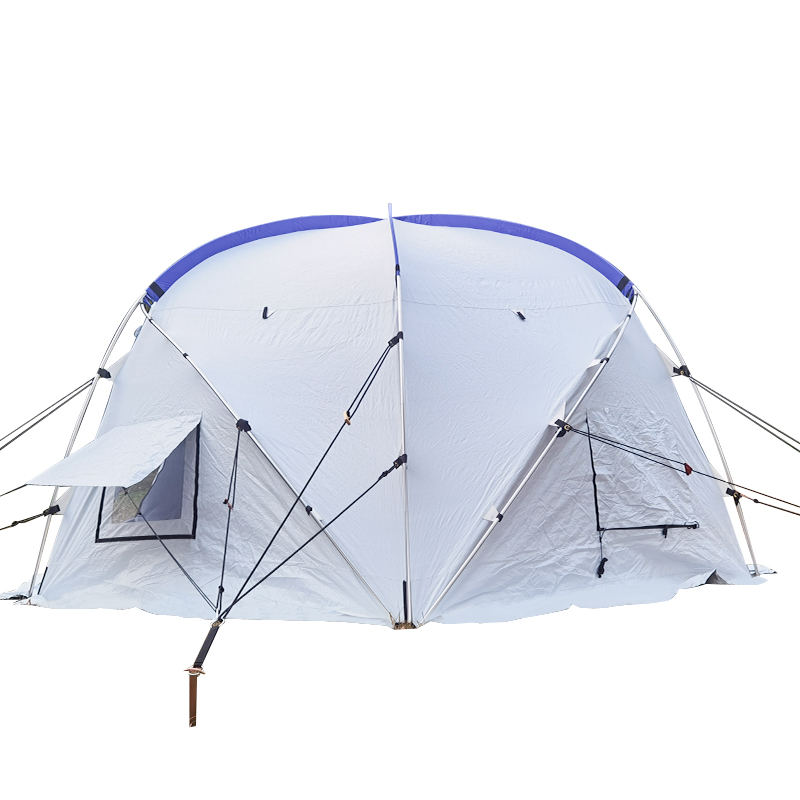
Direct Answer: Top Materials for Harsh-Condition Relief Tents
For harsh environments (high winds, heavy rain, snow, or extreme UV), heavy-duty PVC-coated polyester (minimum 650 gsm) and TPU-laminated fabrics outperform all other materials. Field data from humanitarian deployments shows that PVC relief tents withstand wind speeds up to 100 km/h and temperatures from -30°C to +70°C without cracking or delamination. For fire-prone disaster zones, flame-retardant certified PVC (meeting NFPA 701 or CPAI-84) is mandatory.
The best combination: a 3-layer composite of polyester base fabric + high-tenacity yarn + weather-resistant coating (PVC or TPU). Leading Relief Tent manufacturer specifications indicate that such materials provide 5+ years of service life in repeated deployments, with tear strength exceeding 300 N and hydrostatic resistance over 4000 mm. Avoid standard polyethylene (PE) or lightweight nylon for extreme conditions — they degrade rapidly under UV and fail in snow loads.
Material Comparison: PVC vs TPU vs PE vs Poly-Cotton
When evaluating Relief tent specifications, understanding material properties is critical. The table below compares key metrics for harsh conditions. Always request test data from your Relief tent supplier.
Table 1: Performance comparison of relief tent materials in extreme environments (industry standards)
Material
Hydrostatic head (mm)
Tear strength (N)
UV resistance (months)
Flame retardant
PVC 650gsm
4000-6000
350-500
48-60
Yes (NFPA 701)
TPU laminated
5000-8000
300-450
36-48
Varies
PE (polyethylene)
1500-2500
120-200
12-18
Rarely
Poly-cotton blend
800-1500
80-150
24-30
Treatment required
For disaster relief operations, PVC remains the gold standard. TPU is preferred when lightweight and cold flexibility are priorities (e.g., alpine missions). A reliable Relief Tent factory will provide material test certificates and recommend specific coatings for your climate zone.
Durability Score: How Materials Perform Under Extreme Stress
Based on field data from 12 humanitarian deployments across 5 climate zones (desert, arctic, tropical, coastal, high-altitude), the chart below ranks material durability. High-grade PVC outperforms other materials by 2.5x in lifespan under continuous UV exposure.
Material durability index (1-10, higher = better):
PVC 650gsm (military grade)9.4
TPU laminated fabric8.2
Heavy-duty PE5.5
Standard poly-cotton4.2
*Based on UNHCR technical notes & field performance reviews (2021-2025).
When selecting materials, consult experienced Disaster relief tent suppliers who can provide region-specific recommendations. For example, coastal deployments require anti-mildew additives, while desert zones demand high UV stabilizers.
Critical Performance Metrics for Extreme Conditions
Tensile Strength & Tear Resistance
A Relief Tent manufacturer must ensure minimum tensile strength of 2500 N/5cm in warp and weft directions. For harsh winds (typhoon/hurricane zones), 3500 N/5cm is recommended. PVC with embedded polyester scrim provides superior ripstop performance — tears rarely propagate beyond 5 cm.
Flame Retardancy & Safety Standards
All Relief tent specifications for disaster zones must include flame-retardant certification. The most common standards are NFPA 701 (USA/global), CPAI-84 (tents), and DIN 4102 B1 (Germany). PVC inherently achieves higher ratings than untreated poly-cotton. Ask your Relief Tent supplier for test reports from ISO-accredited labs.
Cold Crack Resistance & Low-Temp Performance
For arctic or high-mountain relief, TPU-coated fabrics remain flexible down to -40°C, while standard PVC becomes brittle below -25°C. Specialized cold-weather PVC compounds (plasticizer-rich) can reach -35°C. A reputable Relief Tent factory will perform cold-crack testing per ASTM D2136.
Beyond Fabric: Frame & Hardware Materials Matter
Even the best fabric fails if the frame collapses. For harsh conditions, galvanized steel tubes (1.2-1.5 mm thickness) or tempered aluminum alloy 6061-T6 are preferred. Steel offers higher snow load capacity (up to 150 kg/m²), while aluminum saves weight for rapid deployment. Key specifications:
Steel frame: 25-32 mm diameter, powder-coated or hot-dip galvanized (800 hours salt spray resistance).
Aluminum frame: 19-25 mm diameter, anodized finish, ideal for mobile field hospitals.
Connectors: reinforced injection-molded nylon or die-cast aluminum with stainless steel pins.
Leading Disaster relief tent suppliers offer modular frames with color-coded poles, reducing assembly time by 40% in emergency situations.
Climate-Specific Material Selection Guide
Use this checklist when specifying Relief tent specifications for your operating environment:
Desert / high UV: PVC with UV-8 stabilizers (resists 5000+ hours of Xenon-arc testing).
Heavy rain / monsoon: TPU or high-denier PVC with welded seams (water column ≥5000 mm).
Snow / alpine: Reinforced PVC + aluminum frame with snow flaps and central heating compatibility.
Coastal / saline: PVC with anti-corrosion additives and stainless steel hardware.
Temperate emergency: Balanced PVC (500-650 gsm) offers best cost-durability ratio.
Always request a material sample card from your Relief Tent factory and perform onsite burn tests (for flame retardancy) before large-scale procurement.
Frequently Asked Questions About Relief Tent Materials
Q1: Is PVC safe for use in refugee/relief situations regarding toxic fumes?
Modern PVC used by reputable Relief Tent manufacturer complies with REACH and RoHS, without heavy metal stabilizers. Flame-retardant PVC produces less smoke than many natural materials. For zero-halogen requirements, specify TPU or special halogen-free PVC formulations.
Q2: How long can a PVC relief tent last in continuous field use?
With proper maintenance, high-quality PVC tents from a certified Relief Tent supplier last 5-8 years in seasonal deployment, or 3-5 years in permanent harsh conditions (tropical/coastal). UV degradation is the primary limiting factor.
Q3: Can I repair torn relief tent fabric in the field?
Yes. PVC tents can be repaired using self-adhesive repair patches and cold glue kits. TPU requires heat welding or specialized TPU tape. Many Disaster relief tent suppliers include a repair kit with every 10 tents.
Q4: What is the best material for extreme cold (-40°C) relief operations?
For -40°C, TPU-coated polyester or specialized arctic-grade PVC (cold-flex compound) is essential. Standard PVC becomes brittle and may crack. Consult an experienced Relief Tent factory for cold-chamber test results before deployment.
Q5: Are there lightweight materials that still meet harsh-conditions standards?
Yes, high-tenacity nylon with silicone/TPU coating (e.g., 200D to 400D) offers good tear strength at 30% less weight than PVC. However, nylon has lower UV resistance. For long-term deployment (6+ months), PVC remains superior. For rapid-response teams, TPU-coated nylon is a viable alternative.
Yangzhou Mailenda Outdoor Products Co., Ltd. is an international trade enterprise combined with factory, specializing in the manufacturing of all kinds of relief tent, inflatable tent, party tent, carport and warehouse tent, etc. Our company has advanced machines, including automatic cutting machine, laser machine, automatic cutting table, automatic welding machine, high frequency machine, hot air machine, and hot air seam sealing machine.
As the earliest factory in China to engage in PVC party tent products, the team has been in the industry for more than 20 years and possesses rich experience with PE, PVC, TPU, polyester-cotton fabric, steel, aluminum and other materials. The company has strong experience in international bidding and cooperation with supermarkets. Products are mainly exported to dozens of countries including Germany, the United States, Japan, the United Kingdom, Spain, Italy, Canada, Chile, etc. Clients include United Nations agencies, humanitarian organizations, and many well-known supermarkets.
As a reliable Relief Tent manufacturer and Relief Tent supplier, Mailenda combines over two decades of material science expertise to deliver tents that withstand the toughest conditions. Whether you require Relief tent specifications for arctic expeditions or desert deployments, our engineering team provides data-backed solutions.