

 English
 中文简体
 Español
 日本語
 русский
 عربى



TO SHELTER ALL, TO SMILE ALL.
Our story is about how to uphold the spirit of humanitarianism in the face of disaster, how to find solutions amidst challenges, and how to sow hope in despair.
Content
If you have ever stood in a supplier's showroom holding two fabric swatches and a price sheet, you already know the problem: the same component gets called three different things on three different pages. The outer layer of a tent is most often called the rain fly in North America, the flysheet in the UK and much of Europe, and the outer tent in brand catalogues and humanitarian tender documents. On large frame tents, the same idea appears as a roof sheet or top cover.
That naming gap is not just trivia. When a relief agency writes a specification, when a wholesaler drafts an OEM brief, and when a factory issues a quotation, the word used for the outer layer determines what gets measured: fabric weight, coating type, hydrostatic head, seam construction and how the sheet attaches to the frame. Getting the term right at the start saves weeks of back-and-forth later.
The outer layer of a tent is called the rain fly, flysheet or outer tent, and it is the single component that decides how weatherproof the whole shelter really is.
The short answer is "rain fly" for most consumer markets, but the vocabulary shifts depending on who is buying. A camping retailer in Germany will ask for a flysheet with a certain coating weight. A procurement officer drafting a family tent tender will specify an outer tent with an inner liner. A marquee rental company in the United States will talk about the roof sheet and the valance. All three are describing the top protective skin of the structure.
There is also a subtle technical difference worth knowing. "Outer tent" usually implies a full-height outer wall that reaches the ground, which is standard in double-wall family and relief tents. "Rain fly" usually implies a separate sheet that covers the roof and upper walls but leaves the lower body exposed. "Roof sheet" almost always refers to a single large welded panel used on frame, warehouse and party tents, where the outer layer is measured by square metres per panel rather than by coverage of a sleeping body.
| Term | Where it is used | What it usually describes |
|---|---|---|
| Rain fly | North America, retail camping | Separate waterproof sheet over the tent body, often covering the roof and part of the walls |
| Flysheet (or "fly") | UK, Europe, trekking brands | Same component as a rain fly; "fly" is the shorthand used in price lists |
| Outer tent | European brands, expedition, humanitarian tenders | Full outer wall of a double-wall tent, sometimes pre-attached to the body |
| Roof sheet or top cover | Marquee, warehouse, relief and military tents | Large welded or sewn panel spanning the frame, often with a valance |
| Storm cover | Older canvas and military patterns | An additional layer over the ridge line for extra rain and wind protection |
Notice that none of these terms describe a decorative part. Each one points to the layer doing the hard work against rain, wind and ultraviolet light. When someone asks what the top layer of a tent is called, the most useful reply is one sentence plus a clarifying question: it is the rain fly or flysheet, and the next question is whether they mean a separate sheet or a fully integrated outer wall.
Rain fly, flysheet and outer tent all name the same protective skin; the difference in vocabulary usually signals the market and the type of tent being bought.
Buyers tend to spend their time on poles and floor fabric because those are the parts they can see and touch at a trade show. In practice, the outer layer is what fails first in the field. It takes direct ultraviolet exposure, it flexes against the frame in gusts, it collects tree sap and bird droppings, and it is the surface that water hits at speed during a storm.
There is a commercial reason to focus on it too. The outer layer is often the most expensive single fabric item on the bill of materials because it needs the widest panels, the most coating, and the most careful seaming. A small change in coating weight or panel layout moves the unit cost more than most buyers expect. That is why experienced procurement teams in relief and retail both spend their review time on the fly sheet specification rather than on the carry bag.
From a performance angle, the outer layer has four jobs at once. It blocks liquid water from passing through the fabric. It sheds wind-driven rain before it can reach seams and zips. It reduces the ultraviolet load on the inner tent, which extends the life of the whole product. And it has to release moisture vapour, or move it away through ventilation, so that the inside of the tent does not turn into a wet box overnight. A fabric that handles three of these jobs and fails the fourth will still produce complaints.
The outer layer is the highest-stress, highest-cost fabric in a tent, so it is where specification mistakes show up fastest and where small savings become expensive returns.
In a double-wall design, the outer layer handles weather and the inner layer handles comfort. The inner tent is built from breathable fabric with mesh panels so that the occupant's moisture can pass through it. The outer layer sits a few centimetres away and stops the rain. That air gap between the two layers is the actual mechanism that keeps the inside dry, because moisture vapour escapes into the gap instead of condensing on the waterproof surface directly above a sleeping person.
Single-wall tents skip the gap. Canvas bell tents, lightweight trekking shelters and many large frame tents use one structural skin, and the fabric itself has to manage both water and vapour. Canvas does this partly by absorbing a small amount of moisture and releasing it slowly, which is one reason traditional canvas tents feel less clammy than their weight suggests. Coated synthetic single-wall tents rely more heavily on ventilation openings, because a solid waterproof coating cannot pass vapour at all.
| Consideration | Double-wall (inner plus outer layer) | Single-wall (one structural skin) |
|---|---|---|
| Condensation control | Moisture collects on the outer layer away from occupants | Moisture can form on the inner surface of the skin |
| Packed weight | Higher, because there are two fabric structures | Lower, which suits trekking and rapid deployment |
| Pitching time | Longer; the fly must be positioned and tensioned | Shorter; one structure to raise |
| Weather resilience | Very high when the fly is properly guyed out | Good, but ventilation management matters more |
| Typical products | Family tents, expedition tents, relief shelters with liners | Canvas bell tents, tipi tents, ultralight shelters, large frame tents |
This is why the same word can confuse a buyer. A relief family tent may be described as having "an outer tent with an inner liner", which is a double-wall structure in everything but name. A canvas bell tent is often described as having "no fly", which does not mean it has no protection, only that the wall and roof are the protection. Whichever construction is chosen, the practical question stays the same: where does the water go, and where does the vapour go?
The outer layer keeps rain out, but the gap between outer and inner layers is what keeps occupants dry from the inside.
Four material families cover almost everything sold today. Each has a different cost structure and a different failure mode, and choosing between them is really a question of where the tent will be used and how long it must last.
Most consumer rain flies are woven polyester, commonly 68 to 210 denier, with a polyurethane coating on the reverse side and a water-repellent finish on the face. Polyester has a useful advantage over nylon: it does not stretch much when wet, so the fly stays tensioned through a rainy night instead of sagging into the inner tent. PU-coated polyester can also be seam-taped cleanly, which matters for volume production because taping is done by machine at a predictable cost.
Nylon offers higher tear strength per gram, which is why ultralight and expedition shelters use it, often in a ripstop weave where thicker yarns are inserted at intervals to stop small tears from running. The trade-off is elongation when wet and, in some constructions, lower ultraviolet stability than polyester. Silicone-coated nylon reaches very high water resistance at low weight, but silicone surfaces are difficult to tape, so those seams are usually sealed by the user with a liquid sealant instead.
Canvas outer layers work differently. Cotton fibres swell slightly when damp, closing the weave, and the fabric then releases moisture gradually. The result is a shelter that feels stable in heat and quiet in wind but is heavy and needs to be stored bone dry. Polycotton blends reduce weight and shrinkage while keeping much of the breathability. For glamping operators and rental fleets, this is often the preferred outer fabric because it can be repaired and re-proofed rather than replaced.
 4 Metre Single-Pole Canvas Tipi Family TentA compact 4 m canvas tipi for family or luxury camping, with single-pole setup, roll-up sides and a top vent suited to a wood-burning stove.View Product →
Canvas products like this single-pole tipi family tent show the single-skin logic in practice: the wall and roof are one continuous protective surface, the load goes through one central pole, and ventilation is handled by strategic openings rather than by a separate fly. It is a good illustration for buyers who assume that a waterproof outer layer must always mean a separate sheet.
Once a tent grows beyond camping scale, the outer layer usually becomes a laminated or coated synthetic sheet. PVC-coated fabric is welded rather than sewn, using high-frequency or hot-air welding, which produces a joint as watertight as the panel itself. PE and HDPE sheet, often woven and laminated, is cheaper and lighter but has a shorter ultraviolet life. These materials dominate warehouse tents, party marquees, vehicle shelters and humanitarian storage units, where the outer layer is measured in square metres and expected to survive years of handling.
Match the outer fabric to the service life you are promising: coated polyester for volume camping, canvas for long-life glamping, and welded PVC for large shelters.
Water resistance on a flysheet is normally quoted as hydrostatic head, measured in millimetres. The test places a column of water on the fabric and records the height at which droplets appear on the other side. A 1,500 mm result is adequate for light summer rain, 3,000 mm handles sustained moderate rain, and 5,000 mm and above is what expedition and long-duration relief shelters target. The number is only meaningful if the test method, usually the ISO 811 or AATCC 127 standard, is stated alongside it.
The chart below shows typical published ranges for common outer-layer constructions. The values are indicative rather than promises, because coating weight, fabric weight and finishing all shift the result within the same material family.
Indicative hydrostatic head ranges in millimetres for common outer-layer materials.
Read the chart as a starting point for conversation, not as a ranking. A welded PVC roof sheet on a warehouse or party tent usually outperforms a camping fly on raw water pressure, but it is far heavier and is not designed to be carried. A light PU fly at 1,500 mm is perfectly serviceable for a weekend tent that is pitched in fair weather and dried at home afterwards. What matters is the pairing of material, coating and expected exposure.
The other half of the waterproofing story sits at the seams. Every stitch creates needle holes, and every needle hole is a potential leak path. Taped seams solve this by heat-bonding a strip of coated tape over the stitching, which is why PU-coated fabrics dominate volume production. Welded construction avoids needle holes entirely, which is why large shelter manufacturers invest in high-frequency welding machines and hot-air sealing equipment rather than sewing the outer layer at all. Where neither taping nor welding is used, the buyer should expect to receive a tube of sealant and a clear instruction to treat the seams before first use.
A hydrostatic head figure means little without the seam treatment beside it; specify coating, taping or welding together, or the number will not hold in rain.
A flysheet is only as waterproof as its tension. If the outer layer sags, water pools in the low point and eventually finds a way through the coating. Two attachment systems dominate. Pole sleeves enclose the frame inside a fabric channel, giving a smooth, strong connection that resists wind well but takes longer to thread. Pole clips snap the outer layer onto the frame at intervals, which is faster to pitch and allows more airflow around the poles, but the fabric has to be cut and reinforced carefully so the clips do not pull through.
On larger frame tents, the outer layer connects through a keder rope slid into an aluminium profile, or through lacing and eyelets along the eaves. Both methods spread the load along the whole panel rather than concentrating it at a few points, which is essential once the roof sheet is measured in tens of square metres. Guy lines and storm flaps then take over the job of holding the panel steady in gusts. A useful reference for pitching discipline is this practical tent setup guide, which covers tensioning order and the details that most often get skipped during a fast build.
Rental fleets and relief stockpiles care about this section more than retail buyers do, because attachment hardware is what wears out. Sleeves abrade, clips crack, keder ropes pull out of their seams. A supplier who can provide spare guy lines, replacement clips and a matching repair patch is worth more over a five-year contract than one who shaves a few percent off the unit price.
Every wrinkle in a rain fly becomes a puddle, so attachment hardware and tensioning procedure are part of the waterproofing specification, not an afterthought.
A perfectly waterproof outer layer can still produce a wet night. Each occupant releases roughly a litre of moisture through breathing and perspiration over a sleep period, and cooking inside adds far more. If that vapour cannot leave, it condenses on the coolest available surface, which is usually the inside of the flysheet or the inner face of a single skin.
Good designs answer this with three moves: a low vent that lets cool dry air in, a high vent under a protective hood that lets warm moist air out, and a gap between outer and inner layers so the condensation forms away from bedding. Some flysheets also use a small mesh panel or a breathable fabric insert at the highest point, which lets vapour escape without creating an obvious opening for rain.
Climate changes the balance. In hot, humid conditions the priority is maximum cross-flow so the tent does not become an oven during the day. In cold conditions the priority is keeping the vents open enough to clear vapour while preventing driven snow from entering. This is exactly why inflatable and air-beam shelters have become popular for rapid deployment: the structure creates large internal volumes and easier vent placement, as discussed in this look at inflatable tents in the field. Buyers comparing designs should ask where the air enters, where it leaves, and what happens to both openings in a crosswind.
Waterproofing stops rain from getting in, but only ventilation stops water from forming inside, so the two must be specified as a pair.
Outside the camping aisle, the outer layer becomes a much bigger engineering item. A humanitarian family tent may use a heavy coated polyester or PVC outer shell with a separate inner liner, sized so that two adults and children can live in it for months rather than nights. A warehouse tent uses a welded PVC or PE roof sheet tensioned over a galvanised steel frame, sometimes with a membrane that resists high temperatures or ultraviolet degradation for years.
Party and event marquees push the outer layer in a different direction: appearance and span. A white PVC roof sheet on an aluminium frame has to look clean from below, resist wind uplift across a wide unsupported area, and remain watertight across panels joined on site. Military patterns often keep the traditional canvas outer with a separate storm cover, because canvas tolerates sparks, repairs easily in the field and does not turn brittle in extreme cold.
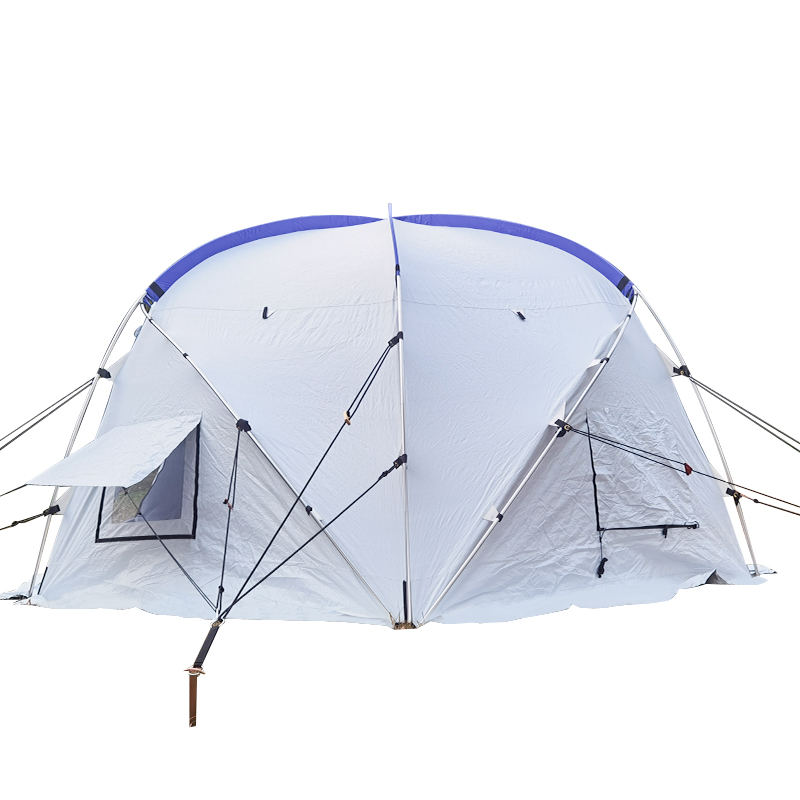
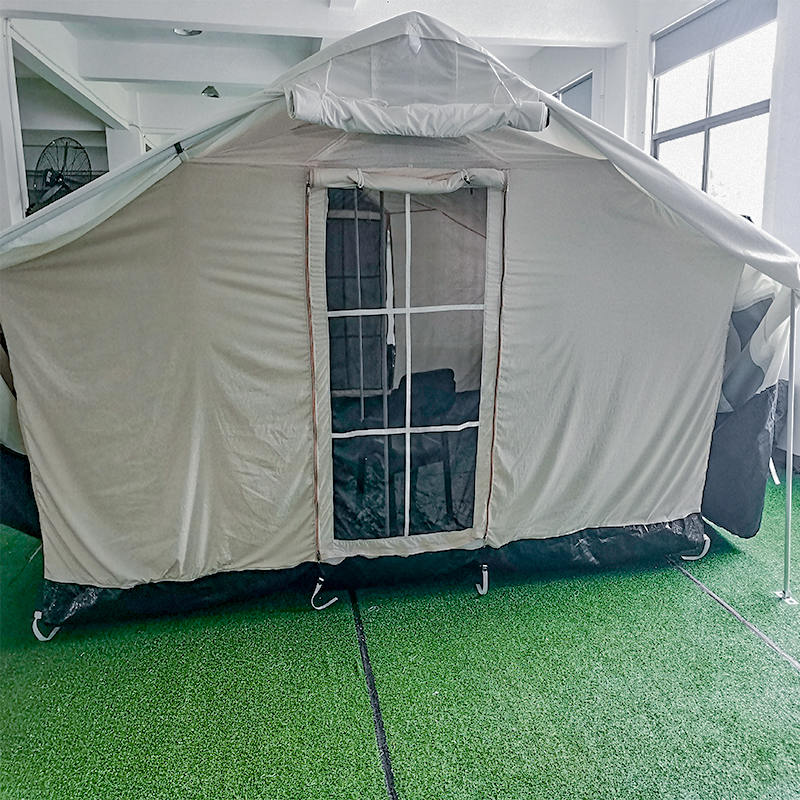 ICRC/IFRC/UNHCR Standard 5-Person All-Weather Family TentA connectable humanitarian family tent with a 320 gsm polycotton outer, sewn-in groundsheet and steel frame, specified for emergency use across climates.View Product →
Products built to recognised institutional standards, such as this double-foldable all-weather family tent, show how the outer layer is treated when the service life is measured in seasons rather than weekends. Here the outer shell, the inner liner, the groundsheet and the frame are all specified as a system, and the outer layer carries most of the durability requirement.
For buyers in this segment, the useful question is not "what is the outer layer called" but "what is the outer layer rated for". Ask for coating weight in grams per square metre, panel width, weld or seam method, ultraviolet exposure hours, and the fire performance standard the fabric has been tested against, such as CPAI-84, NFPA 701 or an equivalent national classification. Those four data points separate a serious shelter supplier from a trader who is quoting a photograph.
On large shelters the outer layer is a structural panel, so coating weight, weld quality and fire classification matter more than the marketing name printed on the catalogue page.
In emergency response, the outer layer is sometimes not a tent component at all. A reinforced plastic tarpaulin thrown over a damaged roof, a leaking fly or a temporary frame becomes the working outer layer for days or weeks. Relief agencies stock them for exactly this reason, and the specification logic is similar: gram weight, weave density, ultraviolet stabilisation, grommet spacing and eyelet reinforcement all decide how long the sheet survives wind.
Woven HDPE tarpaulins in the 90 to 250 gsm range cover most temporary shelter needs, with laminated low-density polyethylene on both faces to close the weave. Heavier PVC-coated sheets cost more but resist abrasion and repeated folding better. The practical detail that catches people out is grommet spacing: a sheet tied only at widely spaced corners will flap, fatigue and tear at the eyelets within a few windy days, no matter how strong the fabric is.
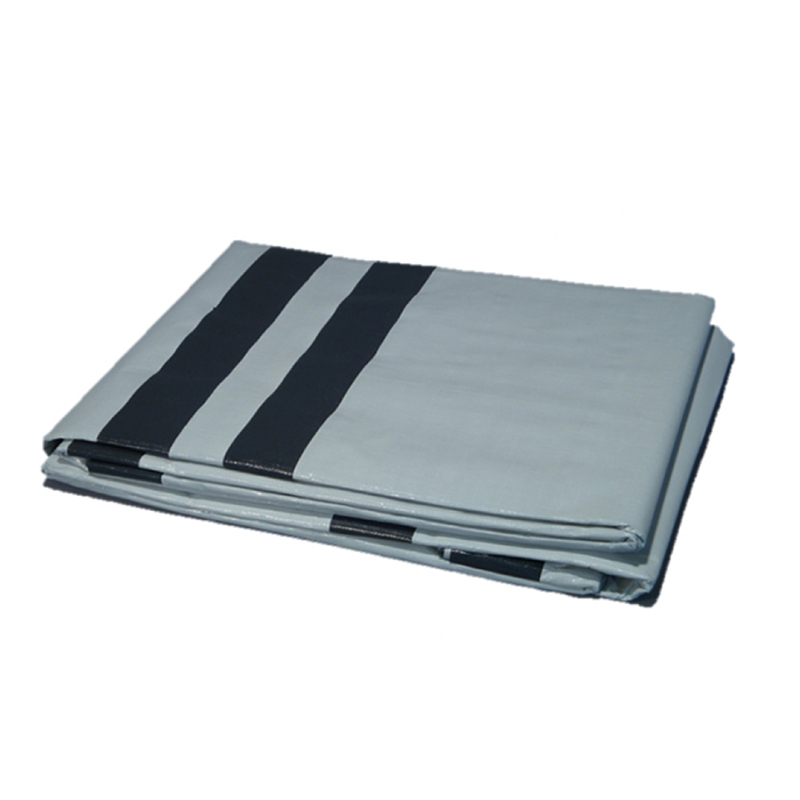 4 x 6 m Reinforced HDPE Emergency TarpaulinA compact 4 by 6 m reinforced HDPE sheet for rapid temporary shelter, with reinforced edges and bands to resist tearing in disaster response.View Product →
A 4 by 6 metre reinforced sheet like this one is a common size for over-roofing a small shelter or creating a dry working area. Used well, it buys time; used badly, it becomes wind-driven debris. The rule of thumb is to support the sheet along its edges rather than only at the corners, and to run a ridge line above the surface so water runs off instead of pooling.
A tarpaulin works as an emergency outer layer only when it is supported along the edges and pitched to drain, never tied by four corners and left to flap.
Most flysheets fail from handling rather than from manufacturing defects. The following mistakes appear again and again in warranty claims and rental fleet inspections:
For a wholesaler or rental operator, a simple maintenance routine extends fleet life considerably: dry the outer layer fully before storage, brush off loose dirt with plain water, re-proof the face fabric every season or two, and keep a stock of repair patches and seam sealant in the same colour as the original. Small habits compound over a five-year cycle.
Rain flies rarely wear out from rain; they wear out from being stored wet, cleaned wrongly and left in the sun.
Whether you are sourcing two hundred family tents for a distributor or twenty thousand square metres of roof sheeting for a rental company, the same checklist shortens the evaluation. A competent manufacturer will answer these without hesitation, and a trading intermediary will usually stall.
Questions about the outer layer are the fastest way to reveal how well a supplier knows their own product. A factory that mixes its own coatings and welds its own panels will usually talk in specific numbers. That level of detail is what separates a long-term supply partnership from a one-off transaction, and it is the reason procurement teams in relief supply chains insist on sample approval before a tender is awarded.
Ask for numbers, not adjectives: fabric weight, coat weight, hydrostatic head and seam method reveal more than any brochure photograph.
It is most commonly called the rain fly or flysheet, and European brands often call it the outer tent. On large frame, warehouse and party tents the same component is usually called the roof sheet or top cover.
Yes. Both terms describe the waterproof outer layer that protects the tent body. "Rain fly" is the usual term in North American retail, while "flysheet" or "fly" is standard in the UK, Europe and most trekking catalogues.
Every tent has some form of outer layer, but not every tent has a separate one. Double-wall tents use a detachable or pre-attached fly over an inner body. Canvas bell tents, tipis and many large frame tents use a single structural skin that performs the same protective role.
Around 1,500 mm suits light summer use, 3,000 mm handles sustained rain in three-season conditions, and 5,000 mm and above is typical for expedition and long-duration relief shelters. The test standard should always be quoted with the figure.
That is usually condensation rather than a leak. Moisture from breathing and cooking condenses on the cool inner surface of the waterproof layer. Opening vents, improving cross-flow and keeping the gap between outer and inner layers intact will reduce it.
For short-term emergency cover, yes, provided the sheet is supported along its edges and pitched to drain. A tarpaulin does not breathe, so long-term use will produce heavy condensation and is not a substitute for a properly designed flysheet.
With dry storage and seasonal re-proofing, a coated polyester fly typically gives several years of regular use, while welded PVC roof sheets on large shelters can last considerably longer. Ultraviolet exposure and folding abrasion are the two factors that shorten life most.
Ask for the base fabric weight, coating type and coat weight, hydrostatic head with test method, seam construction, ultraviolet resistance hours and fire performance classification. A supplier who answers in numbers is usually a safer partner than one who answers in slogans.
Whether you call it a rain fly, a flysheet or an outer tent, the component does the same job: it stands between the occupants and the weather while managing the moisture that builds up inside. Its material, coating, seam construction and tensioning decide how well a tent performs on night one and how long it survives season five.
For buyers working with manufacturers and wholesalers, the practical takeaway is simple. Name the part clearly in the brief, then specify it in measurable terms: fabric weight, coating, hydrostatic head, seam method and ultraviolet performance. For further background on how tent bodies and inner liners are put together, the family tent characteristics overview is a useful companion read to this article.
Further reading from our site
The name matters less than the numbers behind it: a well-specified flysheet, welded or taped at every seam, is what turns a tent into shelter.
Related Products

Our story is about how to uphold the spirit of humanitarianism in the face of disaster, how to find solutions amidst challenges, and how to sow hope in despair.
Copyright © Yangzhou Mailenda Outdoor Products Co., Ltd.
All Rights Reserved.
Custom Tent OEM/ODM Manufacturers


