

 English
 中文简体
 Español
 日本語
 русский
 عربى

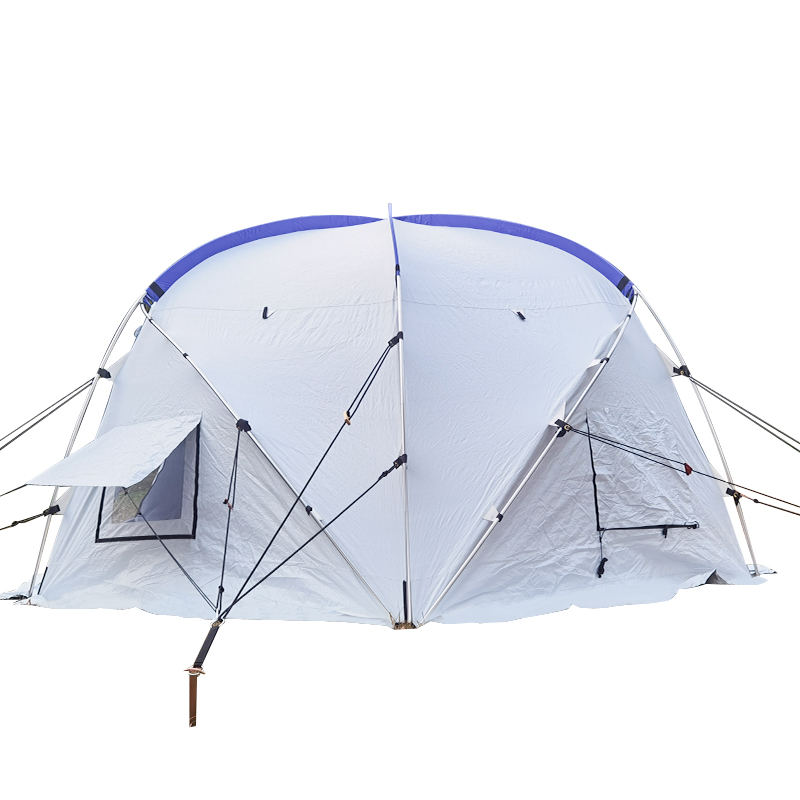


TO SHELTER ALL, TO SMILE ALL.
Our story is about how to uphold the spirit of humanitarianism in the face of disaster, how to find solutions amidst challenges, and how to sow hope in despair.
Content
A pattern repeats in this category. A sample arrives, the fabric looks dense in the photograph, the price is right, and the first order ships. Six weeks later the returns report lands: zippers splitting at the top corner, floors pooling water, poles that bent on the second trip and never straightened again. Nothing was wrong with the sample. What was missing was a written specification that the sample was supposed to represent.
A portable shower tent looks like a small tent. In production it behaves more like a plumbing fixture with a zipper attached. It has to hold its silhouette at noon in direct sunlight, contain several litres of water without wicking it into the seams, let steam out without letting the neighbours in, and fold flat enough to fit a shelf-ready carton, several hundred times over the life of the product.
The short version, before the detail: treat a portable shower tent as four systems, namely privacy panels, a watertight floor tub, a vent path and a folding frame, and lock each of them in writing before you approve a sample. Do that and this becomes one of the most dependable items in a camping or outdoor range. Skip it and your return rate will be decided by whoever happened to run the sewing line that week.
This guide is written for the people who buy, import and resell these products rather than for the camper standing in the queue: importers, wholesalers, distributors, private-label brands, and procurement teams sourcing privacy shelters for field programmes. The observations come from our own production floor in Yangzhou, where the same cutting, high-frequency welding and hot-air seam-taping equipment used for relief shelters and marquees also runs camping and privacy products.
Privacy, drainage, ventilation and fold life are the only four things a portable shower tent truly has to get right. Everything else on the quote is cost engineering.
Most supplier catalogues describe this product by size and colour. Buyers who have been burned once describe it by failure mode. The gap between those two descriptions is where money is made or lost, so it is worth walking through what the product is genuinely being asked to do.
A single-layer 190T polyester panel at a low coating weight reads as opaque on a table and as translucent in the sun. Wet it, stretch it over a frame, and it becomes worse, because the yarns thin out where the panel is under tension. The fix is rarely "buy heavier fabric". It is usually geometry: a darker colour that absorbs rather than transmits light, a door flap that overlaps the zip by 25 to 30 mm, a roof panel that shades the upper wall, and a wall height that keeps the occupant's silhouette below the point where sunlight strikes the side.
Practical targets that hold up in a retail range: an interior footprint of at least 90 x 90 cm so a person can dress without touching the walls, a wall height between 190 and 210 cm, and a floor-level skirt that sits flush with the ground rather than 5 cm above it. A cheap way to check a sample is the shadow test: stand the tent in a dark room, put a bright lamp inside, and look at it from three metres away. If you can read the outline of the lamp from any angle at eye height, the panel is too thin or the colour too light.
The floor is where most complaints start. A sewn-in groundsheet with a 3 cm lip is a puddle waiting to happen. A bathtub floor with a 10 to 15 cm wall, welded or bound at the corners, keeps water inside the tent rather than under it, and it also keeps ground moisture and insects out. Where a drain is included, a corner sump feeding a short hose or grommet is more reliable than a single central eyelet, because users stand wherever they like and rarely aim.
Ventilation is the second half of the same problem. A hot shower in a cold morning produces condensation on the inside of every panel, and condensation that stays folded in a stuff sack for two days becomes mildew. A high mesh vent under the eaves plus a low vent near the floor creates a stack effect and gives the moisture somewhere to go. It also gives the user a place to look out without opening the door.
Pop-up and pole versions both fail at the same point in field data: the joints that get bent most often. Spring wire loses memory after repeated folding, hubs crack where the wire enters, and pole sleeves wear through where the section joints rub. A fold-cycle target written into the purchase order, typically 300 to 500 cycles with an inspection every 100, turns a vague "durable" claim into something a factory can actually test and a buyer can actually reject.
If your specification sheet does not state a floor tub height and a fold-cycle target, you have not specified the two features that generate most warranty claims.
Almost every portable shower tent on the market is one of four constructions, and the choice is a channel decision as much as an engineering decision. A pop-up unit suits an impulse price point on a retail shelf; a rigid panel cubicle suits a worksite where the buyer cares about set-up speed and nothing else. Comparing them on price alone hides the fact that they are sold through different channels to different users.
| Construction | Typical packed weight | Set-up time | Floor and water control | Best channel fit | Main risk |
|---|---|---|---|---|---|
| Pop-up spring-frame cubicle | 1.6 to 2.4 kg | 1 to 2 minutes | Sewn-in sheet, shallow lip | Camping retail, impulse price points | Spring wire fatigue at the hub |
| Pole or frame cabin | 2.5 to 4.5 kg | 5 to 8 minutes | Bathtub floor, 10 to 15 cm wall | Family camping, glamping, rental fleets | Lost poles and sleeve abrasion |
| Inflatable air-frame | 3.5 to 6 kg | 2 to 3 minutes | Welded tub, separate drain point | Premium retail, base camps, fixed sites | Valve seating and chamber leaks |
| Rigid folding panel cubicle | 6 to 12 kg | 10 to 15 minutes | Moulded tray floor | Worksites, relief programmes, events | Hinge wear and transport bulk |
Set-up time drives reviews more than almost any other attribute, and reviews drive reorders. A camper who wrestles a cubicle for ten minutes in the wind writes about it; a camper who erects it in ninety seconds writes about that instead. The chart below places the four constructions side by side using the upper end of typical set-up time, so the spread is visible at a glance.
Indicative set-up time by construction, upper end of typical range
Bars show the upper end of the typical set-up range. Figures are indicative and change with model size, wind conditions and user experience.
The spread explains why so many ranges carry two constructions rather than one. A wholesaler selling into camping retail usually pairs a pop-up cubicle for the opening price point with a pole cabin for customers who have already owned a cheap one. Distributors serving glamping sites and rental fleets lean toward the inflatable air frame, because staff can pitch it in the dark and the chambers tolerate being kicked. Worksite and relief buyers choose the rigid panel unit for the opposite reason: it survives being loaded by people who do not own it.
This is also where our own production range overlaps. The low-pressure inflatable shelters we build for field deployment use the same chamber and valve logic that a premium inflatable cubicle needs, and the pole-and-frame side draws on the same aluminium and steel frame work used across our marquee and storage lines. That matters to a buyer because it means the construction you choose is not a gamble on a supplier learning a new process.
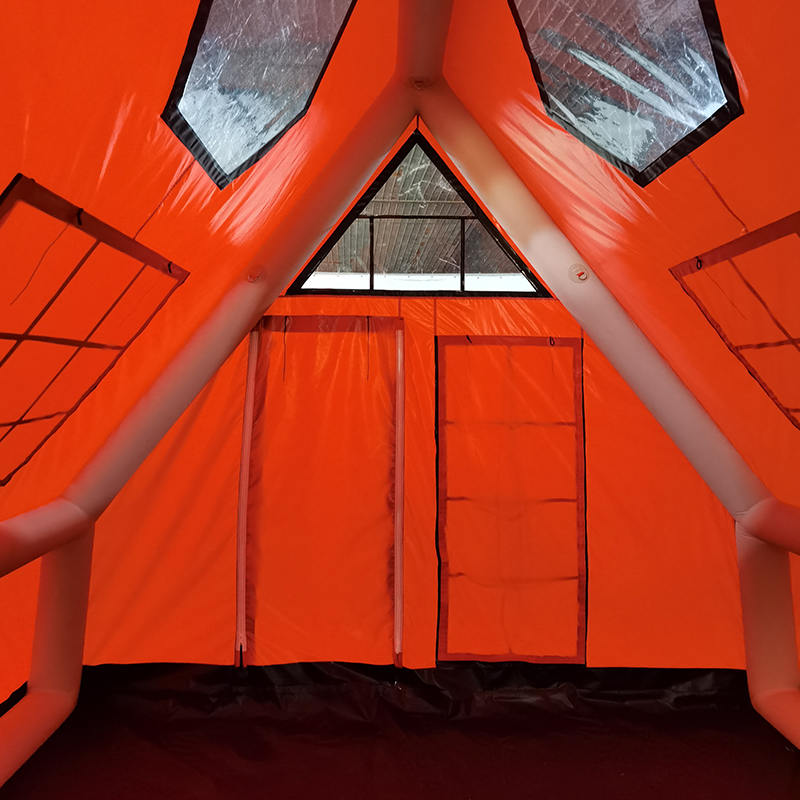 8–10 Person Four Season Inflatable Camping TentA large-group inflatable tent with waterproof polyester shell, PVC columns and 16 m² floor, suited to family camping and rental use.View Product →
Choose the construction by channel first and by price second: pop-up for shelf appeal, pole cabin for family camping, inflatable for premium and rental, rigid panels for worksites and field programmes.
Fabric is the easiest place to win a quotation and the easiest place to lose a customer. Two panels that look identical on a swatch card can differ by 40 percent in weight, by two coating passes and by whether the yarn was UV stabilised. The following are the options that come up most often when a wholesaler asks a portable shower tent manufacturer to quote.
Hydrostatic head is often quoted as a single number, and for this product it is only half relevant. The walls of a shower cubicle rarely face driving rain for hours; they face splashing, condensation and the occasional garden hose. A wall rating in the 800 to 1500 mm range is workable. The floor is the part that deserves 3000 mm or more, plus abrasion resistance, because it takes body weight, gravel and repeated folding on the same crease lines.
Colour matters more than most buyers expect. Mid and dark tones such as charcoal, olive and navy hide a silhouette far better than white or pale grey, and they also hide the grubby handprints that appear on door flaps after a week of use. Light colours photograph better in a catalogue and disappoint more often in the field.
For buyers assembling a kit rather than a single SKU, ground sheets and modesty panels are usually sourced alongside the cubicle. Our plastic sheeting range covers sizes from 4 x 5 m upward, which is useful when a relief or worksite programme needs a separate floor barrier or a screen wall next to the washing point.
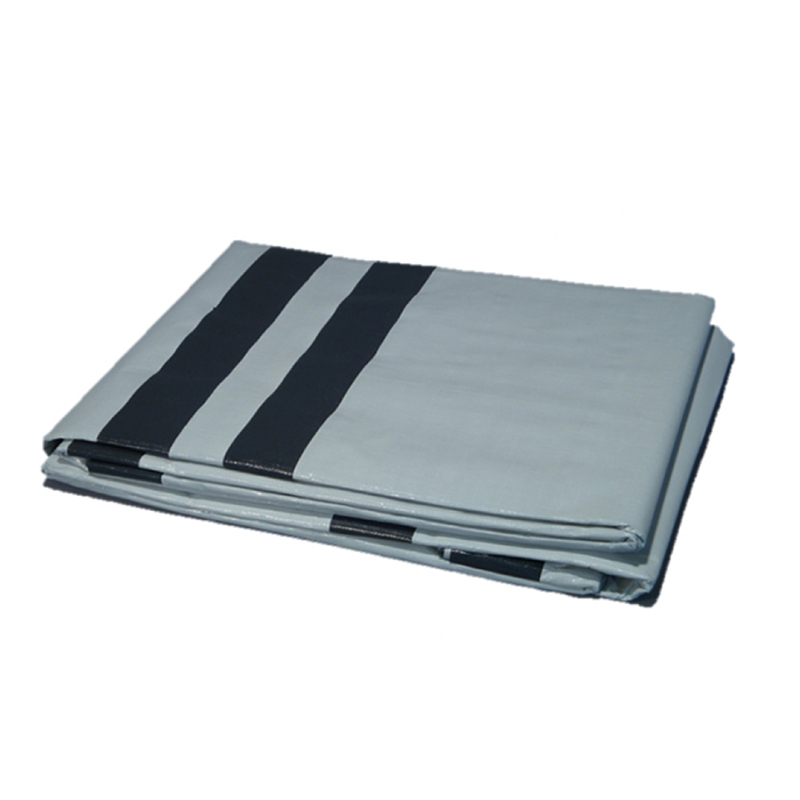 4×6 m Reinforced Emergency Plastic Sheeting TarpaulinA reinforced HDPE/LDPE sheet with black core for opacity, usable as a separate floor barrier or screen beside a washing point.View Product →
Spend the money on the floor and on opacity, not on a headline hydrostatic figure for the walls; the floor and the colour decide whether the customer complains.
Product photography flatters everything. It cannot show wire diameter, stitch density or whether the zip slider is autolocking. Those are the details a supplier should be able to answer in writing, and the ones worth inspecting on a teardown sample rather than on a finished unit.
For pop-up units, spring wire diameter of 6 mm is common and 7 mm is a meaningful upgrade for larger footprints. Fibreglass is lighter and will not rust, but it splinters at the ferrule; steel holds shape better and needs a coating that survives abrasion. For pole cabins, aluminium in the 6061 or 7001 family with a wall thickness of 0.8 to 1.0 mm is the usual balance between weight and bend resistance, and the elastic cord should be shock cord with a UV-stable outer rather than plain elastic that perishes in a season.
A coil zip in size 5 is acceptable on a light cubicle; size 8 is a better match for anything used daily. Two-way sliders let the user open the top for ventilation without exposing the whole interior, an autolocking slider stops the door drifting open in wind, and a zip garage or storm flap over the top of the curve protects the teeth where the zip bends under tension. The single most common warranty photo in this category is a zip that has separated at the top curve, and it is almost always a flap design problem rather than a zip quality problem.
Look for a lock stitch at 8 to 10 stitches per inch, double-stitched main seams, and bar tacks at every point where a guy line, hook or peg loop pulls on the fabric. Bound seams on coated fabric beat raw overlocked seams because they stop the coating from unravelling along the stitch line. Where the buyer needs genuinely welded watertight seams, the production route is high-frequency welding or hot-air seam taping, both of which are standard processes on our lines for relief and storage products.
Carry bags are quoted as an afterthought and returned as a defect. A 210D bag with a webbing handle is fine for a pop-up unit; a 600D bag with a reinforced base is a better match for anything above 4 kg. Specify the bag's internal dimensions with a 15 to 20 mm tolerance over the folded product, because a bag that only fits when folded perfectly will be reported as "too small" by every customer who owns it.
Ask for a teardown sample and check three things: zip curve and flap overlap, stitch density at the stress points, and the internal dimensions of the carry bag.
The commercial side of this product is less glamorous than the fabric side and causes more arguments. A buyer who has not planned for sampling rounds and packaging tooling will usually lose a season, not a shipment.
There are normally three samples, and skipping any of them costs more than it saves. A prototype confirms the construction. A sales sample confirms colour, branding and packaging. A pre-production sample, signed and sealed by both sides, becomes the reference against which the bulk order is inspected. That third sample is the one that ends arguments in month four, so photograph it, label it and keep it on file.
For stock colours and stock cartons, minimum order quantities in the low hundreds per SKU are common in this category. Custom fabric colours, printed carry bags and retail-ready cartons move the number upward because they introduce print set-up and minimum dye lot quantities. Custom moulded parts such as hubs or floor trays carry tooling costs that only make sense at volumes in the thousands.
Agree the drop test before production, not after. A single-unit drop test plus a master carton test to a recognised packing standard catches the two failures that show up in retail DCs: a cubicle that bursts its polybag and a carton that collapses when stacked six high. Specify barcodes, country of origin marking, shipping marks and any retail shelf requirements in the same document as the product spec, because packaging changes made late in the process are the most expensive changes of all.
Production lead time typically starts when the deposit and the approved pre-production sample are both in place. Add transit, port handling and inland distribution on top, then add a buffer for the weeks around Chinese New Year, when capacity tightens across the whole outdoor category. As a manufacturer and trading enterprise with more than twenty years in this industry and shipments to markets including Germany, the United States, Japan, the United Kingdom, Spain, Italy, Canada and Chile, we plan production slots against confirmed samples rather than against good intentions.
Sign and seal a pre-production sample with the packaging in it, then book production against that sample rather than against the catalogue photo.
Most quality problems in this product are visible in the first ten minutes of an inspection if the inspector knows what to look for. The sequence below is the one we run before a container is loaded, and it is worth adopting even if you buy from several suppliers, because a consistent checklist makes suppliers comparable.
Beyond the physical checks, the purchase order itself should read like a specification rather than a shopping list. The fields below are the ones that repeatedly turn out to be missing when a dispute arises, and each one is cheap to agree at the start and expensive to argue about at the end.
| Field | Example entry | Why it matters |
|---|---|---|
| Fabric and coating | 210D ripstop polyester, PU coated, dark grey | Prevents a substitution to lighter goods |
| Fabric weight tolerance | Plus or minus 5 percent per square metre | Gives a measurable accept or reject line |
| Floor construction | Welded bathtub, 12 cm wall, 3000 mm rating | Removes the most common source of returns |
| Zip specification | Coil size 8, two-way, autolock slider, storm flap | Defines the part that fails most often |
| Frame specification | 7 mm spring wire or 0.9 mm aluminium, alloy stated | Stops silent downgrades between orders |
| Fold cycle target | 300 cycles with inspection every 100 | Makes durability testable rather than claimed |
| Packed weight and size | Declared with a 3 percent tolerance | Protects freight budgets and shelf planograms |
| Packaging standard | Drop test level, carton grade, barcode format | Avoids DC rejections on arrival |
| Inspection level | AQL agreed per major and minor defect | Turns opinion into a shared standard |
A purchase order that states fabric weight tolerance, floor wall height and zip size will prevent more claims than any inspection report written afterwards.
Camping retail is the visible market for this product, and it is not the only one. Once a shelter is designed around privacy and water rather than around a campsite aesthetic, a different set of buyers becomes reachable, and those buyers tend to order in larger blocks with longer planning cycles.
Specifications in these channels look different from a retail SKU. A ten-person privacy shelter used at a washing point is closer to a small building than to a camping accessory: it needs a flame-retardant fabric, a replaceable floor, a frame that can be repaired with hand tools, and a packing format that stacks on a pallet. That is the design logic behind the privacy shelters in our relief range, and it is also why the same factory can quote a retail cubicle and a programme shelter without reinventing either.
Buyers assembling a wider field kit usually source shelters alongside multipurpose units, and the multipurpose range is where a sanitation point often sits next to a clinic, a store or a distribution counter. If you are tendering for a programme rather than a single SKU, it helps to have both product families made with the same materials and process controls.
 UNSOS Standard 10-Person Relief Privacy ShelterA galvanized-frame privacy shelter with olive-green fly, inner groundsheet and 30 m² floor area for field washing points.View Product →
A privacy shelter designed for a washing point in a field programme and a shower cubicle sold on a camping shelf share the same four systems, which is why one production line can serve both markets.
Documentation is rarely the reason a buyer chooses a supplier and frequently the reason a container sits at port. The list below covers what most destinations ask for in this category, and it is worth confirming the exact requirement with your own compliance advisor before the order is placed rather than after.
Two practical notes. First, a test report covers the exact material and construction that was submitted, so a fabric substitution between orders invalidates it, which is another argument for writing fabric weight and coating into the purchase order. Second, keep the label artwork in the same version-controlled file as the product specification, because label mismatches are the most common cause of a shipment being held on arrival even when the goods themselves are perfect.
Version-control the label artwork and the fabric specification in one document, because a report that matches the sample but not the bulk order protects nobody.
Two quotes for the same product at the same size can differ by 35 percent and both can be honest. The difference is usually in five places, and a buyer who knows where to look can compare offers properly instead of comparing headline numbers.
Also compare the commercial terms properly: Incoterm, payment schedule, currency, validity period and what happens if the order quantity changes by 20 percent. A supplier quoting a single container price for a mixed order of camping shelters and privacy cubicles will usually be more flexible than one quoting only full container loads of a single SKU, simply because mixed loading is a normal part of what a combined manufacturing and trading operation does.
Finally, ask what the supplier's own test routine is. A factory that folds its pop-up frames ten times before packing, and fills its floor tubs with water before final inspection, has already caught most of what your inspector would catch. That routine is worth more than a certificate hanging in a corridor.
Compare quotes on landed cost and specified materials together, because the cheapest quote is usually the one with the least product inside it.
Floor leakage and zip separation at the top curve, in that order. Both come from design and process decisions rather than from user error, which is why both can be written into a specification and tested before shipment.
A 210D oxford or ripstop polyester with a PU coating in a mid or dark tone suits most retail programmes. It gives reasonable opacity, decent tear strength and a packed weight that stays inside a sensible carton, and it avoids the translucency complaints that follow light 190T panels.
Not always, but if it has one, a corner sump with a short hose is more reliable than a central eyelet. A drain also creates a path for insects and mud, so the design needs a closure or a raised grid that keeps the floor usable when the drain is not in use.
Yes, and many buyers position it that way, but the floor detail changes. A toilet use case benefits from a fully removable or easily cleaned floor panel, while a changing use case tolerates a fixed bathtub. State the intended primary use in the brief rather than after the sample arrives.
Low hundreds per SKU for stock colours and stock packaging is a realistic starting point in this category. Custom fabric colours, printed bags and bespoke retail cartons will raise the number, mainly because of print set-up and minimum dye lot quantities.
Yes. Private label work in this product typically covers the carry bag print, the carton print, the label and the instruction insert. Keep all four in one artwork file with version numbers, and approve a physical sample of each before mass production starts.
Usually by reference to an institutional standard, with the fabric, flame retardancy, floor and repair kit written into the tender documents. Programme shelters also need a packing format that stacks on a pallet and a frame that can be repaired in the field with hand tools rather than a workshop press.
Specify a vent path, print drying instructions on the bag rather than only in the manual, and consider a mesh panel that lets the unit air overnight. No fabric choice prevents mould if the product is folded wet and left in a car boot for three days.
Every FAQ above resolves to the same action: put the answer in the specification document instead of in an email thread.
A portable shower tent is a small, inexpensive product that carries an unusually high number of failure points per square metre of fabric. That is good news for buyers who specify carefully, because the category is full of competitors who do not, and a product that simply does not leak, does not go transparent and does not lose its frame in the second season will keep earning shelf space.
If you take one thing from this guide, take the sequence: decide the construction by channel, lock fabric weight and colour with a tolerance, specify a bathtub floor and a zip size, agree a fold-cycle target, then sign a pre-production sample that includes the packaging. Everything else on the quote is negotiable. Those five points are not.
We build privacy shelters, camping tents, inflatable structures and the tarpaulins and field accessories that go with them, and we quote both retail programmes and institutional tenders from the same production base in Yangzhou. If you are comparing specifications for a portable shower tent range, send the specification rather than the picture and we will tell you what it will cost to build it properly.
Related reading and product families
Related Products

Our story is about how to uphold the spirit of humanitarianism in the face of disaster, how to find solutions amidst challenges, and how to sow hope in despair.
Copyright © Yangzhou Mailenda Outdoor Products Co., Ltd.
All Rights Reserved.
Custom Tent OEM/ODM Manufacturers


