Our story is about how to uphold the spirit of humanitarianism in the face of disaster, how to find solutions amidst challenges, and how to sow hope in despair.
Content
A camping tent is a portable outdoor shelter built from a fabric shell supported by a flexible or rigid frame, and the right type depends mainly on group size, expected weather exposure, packed weight and how often the shelter will be set up and taken down. A lightweight dome or backpacking tent suits solo travel and multi-day trekking, a mid-size family tent suits weekend car camping with several occupants, and a canvas bell or frame tent suits extended stays where comfort and interior headroom matter more than pack weight. The sections below walk through the common camping tent types, how their frame and fabric systems work, where each design performs best, and what to check before placing an order with a camping tent manufacturer.
A camping tent should be selected primarily on group size and expected weather exposure, not on frame style alone.
At its core, a camping tent combines three elements: a fabric shell that blocks wind, rain and sun, a pole or frame system that gives the shell its shape and interior volume, and an anchoring system of stakes and guy lines that keeps the structure stable in changing conditions. Every camping tent on the market is a variation on this basic formula, adjusted for a specific balance of weight, space, weather resistance and setup speed. A backpacking tent trades interior space for low pack weight, a family tent trades pack weight for interior headroom and multiple sleeping areas, and a canvas bell or safari tent trades portability for long-term comfort and breathability. Understanding this trade-off is the fastest way to narrow down which camping tent category actually fits a given use case, whether that use case is a weekend hike, a family holiday, a scouting trip or an outdoor event.
Every camping tent design is a trade-off between pack weight, interior space and setup speed.
Dome tents use two or more flexible poles that cross at the top to form a self-supporting curved structure, which sheds wind and rain well and does not require staking to stand upright, making it one of the most common camping tent shapes for both solo and small-group use.
Backpacking tents are a lightweight subset of the dome family, built with thinner poles and minimal fabric to keep packed weight low for multi-day trekking, generally sleeping one to two occupants.
Family tents scale the dome or tunnel structure up in size, often adding room dividers, extra doors and a taller peak height so several occupants can stand and move around comfortably during weekend or holiday car camping.
Bell tents and canvas tents use a single central pole and a round or bell-shaped canvas wall, giving a spacious, tall-peaked interior that suits glamping, safari-style camping and extended outdoor stays where comfort takes priority over pack weight.
Tipi and teepee tents follow a similar single-pole or pole-free conical design, offering a large open floor area and good ventilation through a peaked roof, and are frequently chosen for group camping and scout activities.
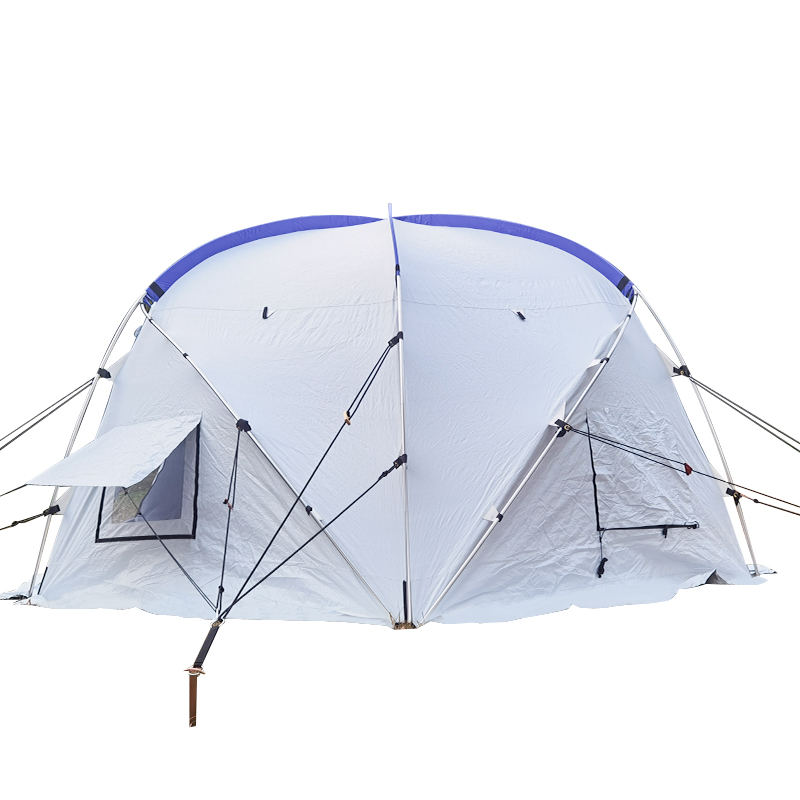
Geodesic dome tents use an intersecting network of poles to distribute structural load more evenly across the shell, which improves stability in wind and snow and makes this design a common choice for exposed or high-altitude camping.
Scout and bow tents use a simple arched or ridge frame and are typically built for durability and repeated group use rather than ultralight portability, making them a practical fit for outdoor education and youth camping programs.
Dome, family, bell and tipi structures cover the large majority of camping tent use cases, from solo trekking to multi-day group stays.
The frame is what gives a camping tent its shape and its ability to resist wind loading. Flexible fiberglass or aluminum poles are bent into an arch or dome and inserted through sleeves or clipped to the fabric, storing tension that keeps the shell taut. Aluminum poles are generally lighter and more resistant to fatigue over repeated setup cycles, which is why they are common in backpacking and higher-use family tents, while fiberglass poles offer a lower-cost alternative suited to occasional recreational use. Single-pole and multi-pole frame tents, including bell and tipi designs, rely on a rigid central support combined with guyline tension rather than pole flex, which produces a taller, more vertical interior wall and better standing headroom.
The fabric shell typically combines two layers: an outer rainfly made from coated polyester or nylon that repels water, and an inner breathable wall or mesh panel that manages condensation and airflow. Canvas, usually a cotton-polyester blend, is used for bell and safari-style tents because it breathes well and insulates against temperature swings, though it is heavier and slower to dry than synthetic fabric. Floor material is generally a heavier-gauge coated fabric than the walls, since it must resist abrasion and ground moisture rather than wind. Seam sealing and taped or welded seams are what actually determine whether a shell stays waterproof under sustained rain, more so than the fabric's stated waterproof rating alone, which is why manufacturing process quality matters as much as raw material choice.
Pole material and seam construction quality influence real-world weather performance more than fabric rating alone.
One of the first questions buyers ask when comparing camping tent types is how many occupants a given structure can reasonably sleep. Capacity depends on floor area, peak height and how much gear storage space is expected inside versus in a vestibule. Backpacking and small dome tents sit at the low end of the scale because they prioritize pack weight over floor area. Mid-size dome and tunnel family tents extend this range considerably, often adding a second sleeping compartment. Bell, canvas and tipi tents extend further still, since their vertical wall design creates more usable floor space relative to their footprint. Large scout or group tents sit at the top of the range and are generally intended for organized outdoor programs rather than individual family use. The horizontal bar chart below lays out a general, illustrative capacity range for six common camping tent categories to make this comparison easier to read at a glance.
Reading the chart from top to bottom shows a fairly steady increase in capacity as tent structures move from lightweight backpacking designs toward larger group and event-oriented shelters. Backpacking tents sit at the bottom of the scale by design, since every gram of fabric and pole material adds to the weight a hiker must carry, so manufacturers deliberately keep the footprint tight around one or two sleeping positions. Dome tents extend the range moderately, offering enough floor space for a small family or group of friends without moving into car-camping-only territory. Family tents mark a clear jump upward, often adding a divider wall to separate sleeping areas, which is one reason this category remains the most commonly purchased camping tent type for weekend and holiday use. Bell and canvas tents extend the usable range further still, largely because their vertical wall design converts a given footprint into more standing and sleeping area than an equivalent dome shape can offer. Tipi and teepee tents push the range higher again, since their open conical floor plan avoids internal poles that would otherwise reduce usable space. Scout and group tents sit at the top of the chart, reflecting their intended role in organized outdoor programs, youth camps and similar settings where a larger number of occupants share one structure. Matching expected group size to the correct capacity range helps prevent both overcrowding and unnecessary excess weight or cost, and buyers evaluating a camping tent manufacturer for a bulk order should always confirm these capacity figures against the specific floor dimensions of the model under consideration, since labeled capacity conventions can vary between suppliers.
Capacity should be checked against floor dimensions, not just the labeled occupant count, before finalizing an order.
Buyers sourcing camping tents in volume, whether for retail, rental fleets or outdoor programs, often need to compare several configurations side by side. The cards below summarize four common group-size configurations and the design features typically associated with each one.
|
1-2 Person Backpacking |
Group size is the fastest starting filter for narrowing a camping tent order down to two or three realistic configurations.
Choosing the right camping tent starts with a clear picture of how and where it will actually be used. For multi-day trekking, pack weight and quick setup take priority over interior space, which points toward a backpacking or lightweight dome tent. For family car camping, occupants generally value standing headroom, room dividers and easy access to gear over minimizing weight, which favors a mid-to-large family tent. For glamping and extended outdoor stays, breathable canvas, a tall vertical wall and a spacious floor plan matter more than portability, which favors a bell or safari-style tent. For scouting, outdoor education and group programs, durability under repeated setup and takedown, along with straightforward frame assembly, tends to matter more than ultralight materials, which favors scout, bow or tipi-style structures.
Selection should start from the intended use case, then work outward to fabric, frame and capacity specifications.
Camping tent frames generally fall into one of two structural categories, and the difference affects both setup convenience and stability in wind.
| Freestanding (Dome/Geodesic) Poles cross to hold the shell upright without staking, which allows the tent to be lifted and repositioned easily and generally makes setup faster. Freestanding designs still require staking for full wind stability, but they perform well on hard or uneven ground where stakes are difficult to drive. |
Non-Freestanding (Bell/Tipi/Frame) A single central pole or rigid frame combined with guyline tension holds the shell in shape, producing a taller vertical wall and larger usable floor area. These structures depend on secure staking and guyline tensioning for stability, so they are better suited to prepared campsites than to rocky or uneven terrain. |
Freestanding designs favor setup speed and terrain flexibility, while non-freestanding designs favor interior space and headroom.
Fabric choice shapes nearly every other property of a finished camping tent, including weight, breathability, weather resistance and expected service life. Polyester remains the most widely used shell fabric across the category because it resists UV degradation and holds its waterproof coating well over repeated exposure. Nylon is favored for the lightest backpacking designs because it offers a strong strength-to-weight ratio, though it can stretch slightly when wet. Cotton-polyester canvas is reserved mainly for bell, safari and tipi-style tents because it breathes well and moderates interior temperature, at the cost of extra weight and slower drying time. PVC-coated and other technical fabrics appear in specialty and heavy-duty applications where maximum waterproofing and abrasion resistance are the priority. The ring chart below presents a general, illustrative breakdown of how these four fabric categories tend to be distributed across camping tent product lines as a whole.
This chart is intended as a general orientation rather than a precise industry statistic, since fabric mix varies significantly depending on which camping tent categories a manufacturer specializes in. Polyester holds the largest illustrative share because it strikes a workable balance between cost, weight and durability across the widest range of tent types, from small dome tents to large family structures. Nylon takes the next largest share, concentrated mainly in backpacking and other weight-sensitive designs where every reduction in fabric mass improves the finished product. Cotton-polyester canvas occupies a smaller but steady share tied specifically to bell, safari and tipi-style tents, where breathability and thermal comfort outweigh the benefit of a lighter synthetic shell. PVC-coated and other technical fabrics make up the smallest illustrative share, reserved for heavy-duty or specialty applications where maximum waterproofing matters more than weight or breathability. No single fabric outperforms the others across every property at once, which is why camping tent manufacturers typically maintain several fabric options rather than standardizing on one material for an entire product range. Buyers evaluating fabric options for a bulk order should request the specific denier, coating type and waterproof rating for the fabric in question, since these details vary between suppliers even within the same general fabric category.
Fabric selection should be based on the intended climate and use case, not on a single material being universally superior.
| Tent Type | Frame Style | Typical Fabric | Setup Time | Best Suited For |
|---|---|---|---|---|
| Backpacking Tent | Lightweight dome, freestanding | Nylon | Short | Solo or two-person trekking |
| Dome Tent | Crossed-pole, freestanding | Polyester | Short to moderate | Small group weekend camping |
| Family Tent | Tunnel or multi-pole dome | Polyester | Moderate | Car camping with several occupants |
| Bell/Canvas Tent | Single center pole, non-freestanding | Cotton-polyester canvas | Moderate to long | Glamping and extended stays |
| Tipi/Teepee Tent | Conical, single-pole or pole-free | Polyester or canvas | Moderate | Group camping and gatherings |
| Geodesic Dome | Intersecting multi-pole, freestanding | Polyester or nylon | Moderate | Exposed, windy or high-altitude sites |
Frame style and fabric together determine setup time, weather performance and ideal use case more than either factor alone.
Setup time is one of the most practical factors buyers weigh when comparing camping tent types, particularly for rental fleets, event use or programs where a tent must be assembled and struck repeatedly. As a general pattern, setup time rises alongside structural complexity, though the relationship is not perfectly linear since some larger designs use simple repeated frame sections that assemble quickly once a crew is familiar with the process. The line chart below plots an illustrative average setup time across five camping tent categories, moving from the simplest backpacking dome through to a larger multi-room or event-style structure. The line rises gradually through the early categories and then more steeply for canvas and large group tents, reflecting the additional guyline tensioning and pole assembly these designs require.
The gentle slope at the start of the line reflects how little assembly a backpacking or small dome tent actually requires, often amounting to little more than feeding two poles through sleeves and staking four corners. The line steepens noticeably once it reaches the family tent category, since these structures generally involve more pole sections, additional guy points and, in many cases, a room divider that adds a small amount of extra assembly time. The steepest portion of the line appears across the bell, canvas and group or event tent categories, which reflects the extra time required to tension a canvas wall evenly, secure a larger number of guylines and, for the largest structures, coordinate assembly among more than one person. This pattern is one of the main reasons rental fleets and outdoor programs often standardize around a single mid-range tent type rather than mixing many different structures, since a consistent setup process reduces training time and speeds up turnover between bookings or sessions. It is worth noting that setup time also depends heavily on crew familiarity and ground conditions, so the figures shown here should be treated as a general planning reference rather than a fixed benchmark for any specific product. Buyers planning large-scale deployment, such as outdoor education programs or rental operations, often request a live demonstration or setup video from their camping tent supplier before finalizing an order, since this gives a more accurate picture than published specifications alone.
Setup time increases with structural complexity, with the steepest jump occurring at canvas and large group tent designs.
A camping tent that is cleaned, dried and stored correctly after each trip will generally hold its waterproofing and fabric strength far longer than one that is packed away wet or dirty. The shell and floor should be wiped free of dirt, sap and debris before packing, since trapped organic material can encourage mildew growth during storage. The tent should always be fully dried, including the floor and any seams, before it is folded and stored, as packing a damp tent for an extended period is one of the most common causes of mildew odor and fabric degradation. Poles should be wiped down periodically and inspected for bent or cracked sections, since a single damaged pole segment can compromise the structural integrity of the entire frame during the next setup. Zippers benefit from an occasional light cleaning to remove grit, which extends their functional life and prevents the fabric around the zipper track from tearing under strain. For canvas tents specifically, allowing natural weathering during the first few uses helps the fibers swell slightly and improves water resistance, while for coated synthetic fabrics, avoiding prolonged direct sunlight during storage helps slow UV-related coating breakdown over time.
Drying a camping tent fully before storage is the single most effective habit for extending its usable service life.
Total packed weight is often the deciding factor between two otherwise similar camping tent options, and that weight is made up of several distinct components rather than a single material. Fabric typically accounts for the largest share of total weight, followed by poles or frame components, with stakes, guylines and the storage bag making up the remainder. The proportion each component contributes shifts noticeably between tent categories, since a backpacking tent is engineered to minimize every component simultaneously, while a canvas bell tent accepts a heavier fabric and frame in exchange for interior comfort. The stacked bar chart below breaks down an illustrative weight distribution across three camping tent categories to show how these proportions shift.
Across all three categories shown, fabric consistently makes up the largest portion of total weight, which explains why manufacturers focused on ultralight backpacking tents devote significant attention to fabric denier and coating weight rather than pole material alone. The backpacking tent bar is the shortest overall, reflecting the deliberate minimization of every component, from a lighter fabric denier to fewer and thinner pole sections and a reduced stake count. The family tent bar grows substantially longer, driven mainly by the additional fabric needed for a larger footprint, taller walls and often a center divider, along with the extra pole sections required to support that larger structure. The bell or canvas tent bar grows longer still, with fabric representing an even larger share of the total, which is consistent with the heavier cotton-polyester canvas used in this category compared with the synthetic fabrics used in dome and family tents. Frame and accessory weight grow more slowly than fabric weight as tent size increases, since a single central pole system, as used in bell and tipi designs, can support a large structure without the proportional increase in pole material that a multi-pole dome frame would require at the same size. This pattern is useful for buyers comparing total shipped weight across a bulk order, since it shows that fabric specification changes will generally have a larger impact on total weight than adjustments to pole material or accessory hardware.
Fabric weight consistently outweighs frame and accessory weight, making it the primary lever for adjusting total pack weight.
For buyers sourcing camping tents in bulk, whether for retail distribution, rental fleets or outdoor programs, evaluating a manufacturer's production capability matters as much as evaluating the finished product itself. Consistent fabric cutting, accurate seam sealing and reliable pole quality all depend on the equipment and process control a factory has in place, since manual variation in cutting or sealing tends to show up later as leaks, uneven wear or frame fit issues. Yangzhou Mailenda Outdoor Products Co., Ltd. is an international trade enterprise combined with its own factory, and its production line includes automatic cutting machines, laser cutting equipment, automatic cutting tables, automatic welding machines, high frequency machines, hot air machines and hot air seam sealing equipment, the same category of process control that supports consistent fabric and seam quality across camping tent product lines. With more than two decades of experience working across PE, PVC, TPU, polyester-cotton canvas, steel and aluminum, the company's manufacturing background spans the material range used throughout the camping tent category, from lightweight nylon backpacking shells to heavier cotton-polyester canvas walls. This experience, combined with a track record of international bidding and supermarket cooperation, along with exports to countries including Germany, the United States, Japan, the United Kingdom, Spain, Italy, Canada and Chile, reflects the kind of scale and process discipline that OEM and ODM camping tent buyers typically look for when selecting a China manufacturer or factory partner for a recurring order.
Consistent seam sealing and cutting equipment are strong indicators of manufacturing quality when evaluating a camping tent supplier.
Q1: What is the main difference between a dome tent and a bell tent?A dome tent uses crossed flexible poles for a freestanding, quick-setup shape, while a bell tent uses a single central pole and canvas walls to create a taller, more spacious interior at the cost of longer setup time. |
Q2: How many people can a typical family camping tent sleep?Most family camping tents are built for four to eight occupants, though actual comfortable capacity depends on floor area and whether gear is stored inside or in a separate vestibule. |
Q3: Which fabric holds up best for extended outdoor use?There is no single fabric that outperforms the others in every condition, since polyester and nylon suit weight-sensitive designs while cotton-polyester canvas suits breathability and thermal comfort in bell and tipi-style tents. |
Q4: Can a camping tent manufacturer produce custom sizes or fabrics?Yes, most established camping tent factories offer OEM and ODM options that allow buyers to adjust dimensions, fabric type and accessory configuration to fit a specific retail or program requirement. |
Q5: How should a camping tent be stored between trips?The tent should be fully cleaned of debris and completely dried, including the floor and seams, before folding and storing it in a cool, dry location away from prolonged direct sunlight. |
Q6: Is a freestanding or non-freestanding tent easier to set up on rocky ground?A freestanding dome or geodesic tent is generally easier to set up on rocky or uneven ground, since it holds its shape from pole tension alone and requires fewer stakes than a non-freestanding structure. |
Related Products
Our story is about how to uphold the spirit of humanitarianism in the face of disaster, how to find solutions amidst challenges, and how to sow hope in despair.
Copyright © Yangzhou Mailenda Outdoor Products Co., Ltd.
All Rights Reserved.
Custom Tent OEM/ODM Manufacturers