Our story is about how to uphold the spirit of humanitarianism in the face of disaster, how to find solutions amidst challenges, and how to sow hope in despair.
Content
Building a tent correctly comes down to three things done in the right order: preparing a stable, level site, assembling the frame or pole structure fully before the cover goes on, and anchoring every stake and guy line with even tension so wind load is distributed across the whole structure rather than concentrated at one point. This sequence applies whether the structure is a small camping dome, a large frame tent for an event, a relief tent for emergency shelter, or a modular general purpose tent used by aid organizations. Getting these three steps right is what separates a tent that stays standing through a storm from one that collapses under load. The rest of this guide walks through the materials, the structural types, and the practical build sequence in detail, using terminology and comparisons that apply across family tents, party tents, military tents, and inflatable rapid deployment shelters alike. Anyone sourcing tents at scale, whether as a relief tent producer, a refugee tent manufacturer, or a buyer for warehouse and storage tent projects, will also find the structural comparisons below useful when specifying which tent type fits a given deployment.
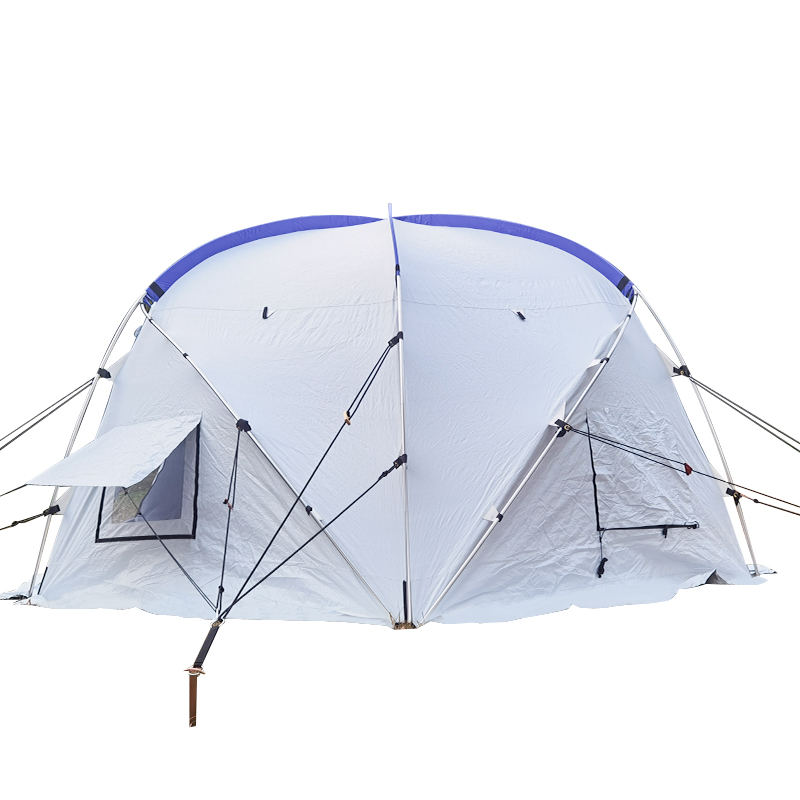
Before any poles go up, the build process starts with matching the tent type to its purpose, since a pole tent, a frame tent, an inflatable tent, and a geodesic dome are assembled in fundamentally different ways. A pole tent relies on center poles and perimeter stakes with fabric tensioned by guy lines, which gives it a classic peaked profile often used for marquee wedding tent and event tent setups. A frame tent, sometimes called a western frame tent, uses a rigid interlocking aluminum or steel frame that supports the fabric without needing center poles, which makes it a common choice for party tent, pavilion, and gazebo style structures where unobstructed floor space matters. An inflatable tent, including low pressure inflatable shelter and inflatable rapid deployment tent designs, uses air filled beams instead of rigid poles, allowing a family tent or an emergency shelter to be raised in minutes with a pump rather than manual pole assembly. A geodesic dome or bow tent uses curved interlocking poles arranged in a triangulated pattern, which distributes wind load evenly and is why this shape is favored for scout tent, camping tent, and high wind expedition use. Understanding which category a given tent falls into before starting assembly avoids the most common building mistakes, such as attempting to tension a frame tent cover before the frame is fully locked, or trying to raise an inflatable rapid deployment tent without first checking the low pressure valve seals.
The material used for the cover and frame has as much influence on tent performance as the structural shape itself. PVC coated fabric is widely used for relief tent, disaster tent, and storage tent covers because it resists tearing, sheds water effectively, and holds up under repeated setup and takedown cycles typical of humanitarian deployments. PE tarpaulin and plastic sheeting are common for lighter duty shelter kit components and temporary covers where cost efficiency and quick replacement matter more than long service life. TPU coated fabric is increasingly used for inflatable tent and inflatable family tent structures because of its flexibility and its ability to bond well at seams under air pressure. Polyester-cotton canvas remains the material of choice for bell tent, safari tent, and glamping tent products, where breathability and a traditional appearance are valued alongside water resistance. Frame materials follow a similar logic: aluminum frames are lighter and easier to transport for portable garage, carport, and car shelter applications, while steel frames are chosen for military tent, army tent, and large multipurpose tent structures where load bearing capacity across a wide span is the priority.
| Material | Typical Use | Key Trait |
|---|---|---|
| PVC coated fabric | Relief tent, warehouse tent | Durable, water resistant |
| PE tarpaulin | Shelter kit, plastic sheeting | Lightweight, economical |
| TPU coated fabric | Inflatable tent, inflatable shelter | Flexible, seam bonding |
| Polyester-cotton canvas | Bell tent, safari tent, glamping | Breathable, traditional look |
| Aluminum frame | Carport, portable garage | Lightweight, portable |
| Steel frame | Military tent, MGPT | High load capacity |
Regardless of whether the structure is a small camping dome or a large modular general purpose tent, the build sequence follows the same logical order, and skipping a step is the most common cause of an unstable setup.
This sequence applies to a family tent set up for a weekend trip just as much as it applies to a large relief tent deployment following a disaster response, where a field team may need to erect dozens of units in a short window. For frame tents and pole tents, the frame or pole structure should always reach its fully locked position before fabric tensioning begins, since tensioning an incomplete frame can bend connector joints and weaken the entire structure over repeated use.
One of the most practical questions when planning a build is how much time a given tent type takes to raise from start to finish. Setup speed varies significantly between an inflatable tent, a frame tent, a pole tent, and a geodesic dome because each relies on a different assembly method. This comparison is especially relevant for relief tent producer and refugee tent manufacturer planning, since faster setup can matter during emergency shelter deployment. The horizontal bar chart below presents a general, relative comparison of setup speed across four common structural categories, expressed as a qualitative rating rather than a fixed timed benchmark, since actual setup time depends on crew size, tent dimensions, and site conditions. Reading this chart alongside the material comparison above gives a fuller picture of which tent type suits a fast deployment scenario versus a semi-permanent installation.
The chart shows that inflatable tent and inflatable rapid deployment tent structures generally rate highest for setup speed, since air beam systems can be raised with a pump and require no pole assembly, which is why this category is closely associated with emergency shelter and disaster tent response scenarios. Frame tents rate as moderate for setup speed because the interlocking frame requires several connection points to be joined before the cover goes on, but the resulting structure offers strong stability once complete, which suits multipurpose tent and party tent applications used repeatedly over a season. Pole tents also fall into the moderate category, since center poles and perimeter staking take coordinated effort but do not require the frame assembly steps a frame tent needs. Geodesic dome and bow tent structures are rated as requiring a more careful build, since the triangulated pole pattern must be assembled with attention to correct pole placement, though this careful assembly is precisely what gives the geodesic shape its strong wind resistance once complete. It is worth noting that setup speed is only one factor in choosing a tent type, and a structure that goes up quickly is not automatically the right choice for every application. A high performance tent used as a dispensary tent or hospital tent in a medical deployment, for example, may prioritize internal floor space and ventilation over raw setup speed. Similarly, a modular general purpose tent designed for long term warehouse tent or storage tent use is generally built for durability and modular expansion rather than for the fastest possible raise time. Buyers evaluating options as a relief tent producer or refugee tent manufacturer should weigh setup speed against the expected deployment duration, since a structure raised quickly but intended for months of continuous use still needs a frame or pole system rated for sustained load. This is why many humanitarian shelter kit programs use a mix of inflatable tent units for the first response phase and frame tent or MGPT units for longer term camp infrastructure. The relative comparison shown here is intended as a general planning reference rather than a precise timed benchmark for any specific product line.
Once a tent type is selected, understanding where time is typically spent during assembly helps a build crew plan resources more efficiently. The build sequence generally divides into four stages: site preparation, frame or pole assembly, cover fitting, and anchoring with guy line tensioning. Each of these stages consumes a different share of total build time depending on tent size and structure type. The line chart below traces a general, illustrative allocation of build effort across these four stages for a mid sized frame tent or pole tent, based on the sequence described earlier in this guide. This view is useful for planning crew tasks during a large deployment involving multiple relief tent or event tent units, since different stages can sometimes be run in parallel by separate teams.
The line chart shows that frame or pole assembly typically consumes the largest share of build effort, which matches the practical reality that connecting multiple frame joints or raising and cross bracing center poles is the most labor intensive part of the process. Site preparation takes a smaller but still meaningful share of time, since clearing debris and confirming ground levelness protects both the groundsheet and the structural integrity of the finished tent. Cover fitting takes a moderate share of effort, and this stage often requires two or more people working together to avoid twisting large canvas or PVC coated fabric panels during placement. Anchoring and guy line tensioning shows a rising share of effort toward the end of the sequence, reflecting the importance of methodical, even tensioning rather than a rushed final step. This pattern generally holds true across pole tents, frame tents, marquee wedding tent setups, and pavilion or gazebo structures, though the exact proportions shift for very large multipurpose tent installations where frame assembly can dominate an even larger share of total time. For inflatable tent and low pressure inflatable shelter designs, this profile changes substantially, since air beam inflation replaces the frame or pole assembly stage almost entirely, shifting the bulk of effort toward site preparation and anchoring instead. Recognizing this difference is one reason inflatable rapid deployment tent systems are specified for emergency shelter programs where crew time is limited and speed matters more than the finishing details required for a permanent event tent or pavilion installation. Teams managing multiple simultaneous builds, such as a warehouse tent expansion project or a large refugee tent camp, can use this general effort profile to schedule labor across stages rather than assuming every stage takes equal time. Recognizing where effort concentrates also helps identify where additional trained crew members will have the greatest impact on reducing total build time. This kind of planning view complements the setup speed comparison shown earlier, since together they describe both how long a tent takes overall and where that time is spent within the sequence.
A complete tent system is made up of more than the cover fabric itself, and understanding the general composition of components helps buyers plan procurement for a full deployment rather than the tent alone. A typical relief tent or family tent system includes the fabric cover, the frame or pole structure, ground anchoring hardware, and accessory items such as guy lines and door fittings. Humanitarian shelter kit programs often bundle a tent with related relief items, including plastic tarpaulin, sleeping mat, folding bed or field cot, and thermal blanket, since a shelter alone does not fully address a household's needs after a disaster. The donut chart below illustrates a general, representative composition of components within a bundled relief tent and shelter kit package, based on how these bundles are typically structured for aid distribution. This composition view is useful context for a warehouse tent or storage tent buyer coordinating a wider relief items order rather than a single product line.
The donut chart shows that the tent cover and frame structure typically forms the largest single share of a bundled relief tent and shelter kit package, which reflects its role as the primary structural item within the bundle. Plastic tarpaulin and plastic sheeting make up the next largest share, since these flexible materials are used both as an additional groundsheet layer and as a general purpose covering for repairs or supplementary shelter needs. Sleeping mat, folding bed, and field cot items form a smaller but still significant share, providing the basic sleeping surface that complements the tent structure itself. Thermal blanket and smaller accessory items round out the composition, covering warmth and the practical fittings, such as water container or jerry can and bucket items, that are often distributed alongside a shelter kit. This general composition illustrates why a relief tent producer or refugee tent manufacturer capable of supplying a fuller range of relief items, rather than the tent alone, is often better positioned to support large scale humanitarian procurement programs. Buyers coordinating a shelter kit order for a disaster tent or emergency shelter response typically need to plan logistics for all of these component categories together, not the tent cover in isolation. A manufacturer with production capability across PE, PVC, TPU, and canvas materials, along with metal frame components, is generally in a stronger position to supply this kind of bundled composition consistently. This is particularly relevant for organizations managing MSU relief items programs, where consistency of component quality across a large shipment matters as much as the specification of any single item. Understanding this composition also helps a buyer estimate container loading and shipping volume more accurately, since tarpaulin, sleeping mats, and blankets add meaningful bulk alongside the tent structure itself. Recognizing the full scope of a shelter kit bundle, rather than focusing only on the tent, supports more realistic budget and logistics planning for large scale relief and refugee tent programs.
Different tent categories are engineered around different priorities, and comparing them across several performance dimensions at once gives a clearer picture than looking at any single feature alone. Wind resistance, load capacity, portability, and interior space are the four dimensions most relevant to buyers choosing between a frame tent, an inflatable tent, and a geodesic dome for a specific application. A high performance tent designed for exposed sites will typically be engineered differently from a portable garage or carport designed mainly for vehicle protection in a residential setting. The radar chart below compares three representative structural categories across these four dimensions on a general, relative basis to support this kind of comparison. This visualization is intended to help a buyer or specifier think through trade offs rather than to represent a fixed numeric benchmark for any single product.
The radar chart illustrates that geodesic dome and bow tent structures generally score well on wind resistance, since their triangulated pole geometry distributes stress evenly across the shell, which is why this category is often chosen for scout tent and backpacking tent use in exposed outdoor conditions. Frame tents tend to score strongly on interior space and load capacity, since their rigid frame supports a large unobstructed floor area suitable for multipurpose tent, storage tent, and warehouse tent applications where usable space matters more than portability. Inflatable tent structures score comparatively higher on setup speed, consistent with the earlier comparison of build time across structure types, making them well suited to inflatable family tent and emergency shelter contexts where fast deployment is the priority. Portability tends to favor lighter structures such as backpacking tent, dome tent, and smaller family tent designs that pack down compactly for transport by a small team. It is important to view this radar comparison as a general engineering trade off map rather than a strict ranking, since a well engineered structure in any category can be optimized further depending on the specific frame gauge, fabric weight, and anchoring hardware selected. A carport or portable garage, for example, is generally optimized for load capacity over a vehicle rather than for the interior floor space metrics relevant to a party tent or pavilion. Similarly, a livestock tent or pasture tent used for corral shelter purposes prioritizes weather protection and durability over rapid setup, since these structures are typically installed for extended seasonal use rather than single event deployment. Buyers evaluating a modular general purpose tent for humanitarian use should weigh wind resistance and load capacity heavily, given the exposed conditions many relief deployments face, while an event planner selecting a marquee wedding tent or sukkah structure may weigh interior space and finished appearance more heavily. This kind of multi-dimensional comparison reflects how experienced buyers and specifiers actually evaluate tent categories in practice, rather than relying on a single headline feature such as setup speed alone. Reading this radar chart alongside the material comparison table earlier in this guide gives a more complete basis for matching a tent category to a specific application.
Visualizing the build sequence in three dimensions helps clarify how the frame, cover, and anchoring stages fit together on a completed structure. The isometric diagram below shows a simplified frame tent silhouette with its supporting frame legs, peaked roof line, and perimeter anchor points labeled schematically. This kind of diagram is a general structural illustration rather than a photograph of a specific product, and it is intended to support the step by step description given earlier in this guide. Reviewing this diagram alongside the written build sequence can help a first time crew visualize how the finished structure should look once anchoring is complete. Frame tents built for party tent, pavilion, or multipurpose tent use generally follow this same basic silhouette regardless of overall size.
Tent structures serve a wide range of purposes beyond recreational camping, and recognizing this range helps clarify why so many structural types exist side by side in the market. Emergency and humanitarian applications include relief tent, refugee tent, disaster tent, emergency shelter, dispensary tent, hospital tent, and modular general purpose tent deployments coordinated by aid organizations and MSU relief items programs. Commercial and event applications include marquee wedding tent, event tent, pavilion, pagoda, gazebo, high peak tent, stretch tent, stretch marquee, and flex tent structures used by venues and event planners. Storage and vehicle protection applications include warehouse tent, storage tent, portable garage, carport, and car shelter structures used by businesses and homeowners for equipment and vehicle protection. Agricultural and outdoor applications include greenhouse, polytunnel, livestock tent, pasture tent, and corral shelter structures that protect crops and animals from weather exposure. Recreational applications span canvas tent, bell tent, safari tent, glamping tent, camping tent, geodesic dome, scout tent, bow tent, tipi tent, teepee tent, backpacking tent, and dome tent categories, each suited to a different balance of comfort, portability, and setup effort. A manufacturer capable of producing across this full range, from military tent and 5 men tent or 10 men tent field configurations through to inflatable family tent and party tent products, is generally better equipped to support varied procurement needs from a single supply relationship.
Yangzhou Mailenda Outdoor Products Co., Ltd. is an international trade enterprise combined with its own manufacturing base, specializing in relief tent, inflatable tent, party tent, carport, and warehouse tent production. The company operates advanced equipment, including automatic cutting machines, laser cutting machines, automatic cutting tables, automatic welding machines, high frequency welding machines, hot air machines, and hot air seam sealing machines, supporting consistent quality across PE, PVC, TPU, polyester-cotton fabric, steel, and aluminum material types. Yangzhou Mailenda is recognized as one of the earliest factories in China to engage in PVC party tent production, and its team brings more than twenty years of industry experience across fabric, frame, and hardware components. The company has extensive experience in international bidding processes and cooperation with supermarket chains, and its products are exported to dozens of countries and regions, including Germany, the United States, Japan, the United Kingdom, Spain, Italy, Canada, and Chile. Its customer base includes United Nations agencies, humanitarian organizations, and a number of well known supermarket groups, reflecting its capability to support both emergency relief procurement and commercial retail supply requirements.
Q1: What is the correct order for building a tent?
The general order is to clear and level the site, assemble the frame or pole structure fully, fit the cover, then stake and tension guy lines evenly around the perimeter before final checks.
Q2: What is the difference between a frame tent and a pole tent?
A frame tent uses a rigid interlocking frame with no center poles, giving open floor space, while a pole tent relies on center poles and tensioned guy lines for its classic peaked shape.
Q3: Why do inflatable tents set up faster than frame tents?
Inflatable tents use air filled beams raised with a pump instead of manually assembled rigid poles or frame joints, which is why inflatable rapid deployment tent designs are used for emergency shelter response.
Q4: What material is best suited to relief tent applications?
PVC coated fabric is widely used for relief tent and storage tent covers because of its resistance to tearing and water, while canvas is preferred where breathability matters more, such as bell tents.
Q5: What items are typically included alongside a relief tent in a shelter kit?
A shelter kit commonly bundles the tent with plastic tarpaulin, sleeping mat or folding bed, thermal blanket, and basic items such as a water container or jerry can and bucket.
Q6: Which tent structure offers the strongest wind resistance?
Geodesic dome and bow tent structures generally distribute wind load evenly through their triangulated pole geometry, making this shape a common choice for exposed outdoor conditions.
Related Products
Our story is about how to uphold the spirit of humanitarianism in the face of disaster, how to find solutions amidst challenges, and how to sow hope in despair.
Copyright © Yangzhou Mailenda Outdoor Products Co., Ltd.
All Rights Reserved.
Custom Tent OEM/ODM Manufacturers