

 English
 中文简体
中文简体 Español
 日本語
日本語 русский
 عربى
عربى



TO SHELTER ALL, TO SMILE ALL.
Our story is about how to uphold the spirit of humanitarianism in the face of disaster, how to find solutions amidst challenges, and how to sow hope in despair.
Content
The core difference between a relief tent and a multi-purpose shelter tent lies in certification, structural specification, and deployment context. A standard emergency tent is typically a lightweight, minimal-specification structure for short-term individual or family occupancy — adequate for immediate post-disaster shelter but not engineered for extended use as a clinic, school, or administrative hub. A multi-purpose shelter tent meeting ICRC/IFRC standards — such as the MPBT33 33.6m² Base Tent — is purpose-designed and independently certified for prolonged humanitarian deployment, capable of accommodating 15 to 30 people across a broad range of functional configurations including living quarters, temporary clinics, warehouses, and command centres.
If you are procuring shelter for a refugee camp tent programme, a disaster relief tent distribution, or a medical field operation that requires a temporary clinic tent, understanding this distinction determines whether your selected product will perform reliably over months of continuous use or fail prematurely under real field conditions. This article examines every dimension of that distinction — from fabric specification and structural engineering to optional accessories and logistical footprint.
The International Committee of the Red Cross (ICRC) and the International Federation of Red Cross and Red Crescent Societies (IFRC) maintain technical specifications for all humanitarian shelter solutions procured and distributed through their supply chains. These standards address fabric weight and treatment, structural load capacity, dimensional consistency, packing volume, and accessory compatibility — covering the full operational lifecycle from factory production through field deployment and extended use.
An IFRC shelter tent or ICRC relief tent that meets published specifications has been independently verified against measurable technical criteria. This matters for procurement officers, logistics coordinators, and field programme managers because it removes subjectivity from quality assessment: a certified tent either meets the specification or it does not. Non-certified products may claim comparable quality through marketing language but cannot provide the independent test evidence that UN agencies, humanitarian organisations, and government procurement bodies require for compliant purchasing.
The MPBT33 meets MSF/ICRC/IFRC standard — a combined specification that covers both ICRC supply catalogue requirements and MSF (Médecins Sans Frontières) field procurement standards. This dual compliance makes it one of the most widely accepted humanitarian tent supplier products for multi-agency field operations where different organisations are deploying from a shared site or coordinating logistics through a common hub.
The bar chart compares an ICRC/IFRC-certified multi-purpose shelter tent against a basic emergency shelter tent across five dimensions. The certified tent scores 9.6 for structural durability, reflecting its aluminium pipe frame system (40/2mm diameter), heavy-duty fabric weights, and engineering designed for multi-month deployment in field conditions. Multi-use flexibility achieves the highest score of 10, confirming its suitability across configurations ranging from family accommodation and temporary clinic tent to warehouse, school, and office use. Certification level scores 9.8 — the highest achievable for a product that meets both ICRC and IFRC standards concurrently. By contrast, basic emergency tents score between 2.0 and 5.8 across these dimensions, confirming that their role is immediate first-response shelter rather than sustained operational deployment. The capacity score of 9.4 reflects the MPBT33's 15–20 person accommodation figure, which can extend to 30 persons under emergency mass-occupancy conditions — a range that no standard family tent can approach. This comparison clearly illustrates why procurement for extended humanitarian operations requires a fundamentally different product specification from immediate disaster response distribution.
The fabric specification of a humanitarian tent supplier product directly determines how long it will perform, under what climatic conditions, and whether it will protect occupants from rain, UV degradation, rot, and insect penetration over months of continuous exposure. The MPBT33 uses differentiated fabric specifications for each structural zone — a design approach that optimises protection where it is most needed without adding unnecessary weight across the entire structure.
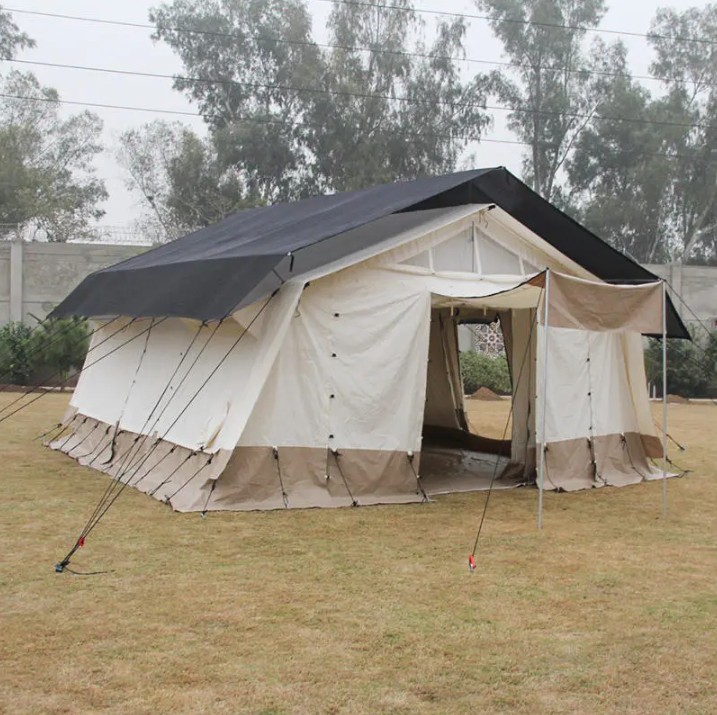
The product photograph shows the MPBT33 multi-purpose shelter tent fully deployed on a grass site. The dark-coloured roof fly sheet demonstrates the UV-protective outer layer over the cream polyester-cotton main roof, providing an additional thermal shading effect that reduces heat gain in the tent interior under direct sun exposure. The wall panels are raised on the windward side — a standard field configuration for cross-ventilation in hot climates — and secured using the integrated rollup and tie system visible in the photograph. The aluminium pipe uprights at the entrance confirm the 3.00m central height specification that enables upright movement within the structure and distinguishes this product from lower-profile dome tent or frame tent configurations that restrict interior functionality. The tan mud flap skirt running around the full perimeter is clearly visible, showing how the heavier PVC-coated material creates a sealed ground contact zone independent of the wall fabric above it.
| Parameter | Specification | Field Implication |
|---|---|---|
| Item No. | MPBT33 | MSF/ICRC/IFRC catalogue reference |
| Dimensions | 5.60 × 6.00 m | Modular — connectable for extended structures |
| Central Height | 3.00 m | Full standing height for all occupants |
| Wall Height | 2.11 m | Maximises usable vertical space along walls |
| Usable Area | 33.60 m² | Sphere minimum for 15-person clinic or office |
| Capacity | 15–20 persons | Expandable to 30 in emergency density |
| Roof Fabric | 440 GSM Polyester-Cotton, Water+Rot+UV | Multi-year outdoor exposure rating |
| Wall Fabric | 320 GSM Polyester-Cotton, Water+Rot+UV | Independently operable wall panels |
| Mud Flap | 540 GSM PVC Coated | Waterproof ground seal, abrasion resistant |
| Frame | Aluminium Pipe Ø40/2mm | Lightweight, corrosion-resistant, field-repairable |
| Unit Weight | 130 kg | Requires 4–6 persons for transport and erection |
| Packed Volume | 0.435 m³ per unit | 48 units per 20' container |
| Container Loading | 20': 48 units | 40': 96 units | Efficient for large-scale relief procurement |
One of the defining advantages of the modular shelter tent design over single-application emergency tent formats is its ability to connect multiple units end-to-end, creating elongated structures of any required length. A refugee camp tent programme deploying 96 units from a 40' container can configure them as 96 individual 33.6m² shelters, as 48 double-unit 67.2m² structures, or as a single continuous structure covering a full camp block — depending on the operational requirement at the time of deployment.
This modularity mirrors the connection capability found in purpose-built warehouse tent and storage tent formats — the same principle that enables a portable garage or carport structure to be extended by adding bays. In a humanitarian context, the practical application is immediate: a medical programme that begins with a single dispensary tent or hospital tent can expand to a full field hospital complex by connecting additional base tent units without purchasing a different product or system. The standardised aluminium pipe structure ensures that connection points, ridge heights, and wall dimensions align precisely between units.
For comparison, commercial tent structures such as frame tents, western frame tents, and high peak tents used in event and hospitality contexts operate on a similar bay-extension principle. The marquee and stretch marquee sector calls this a "modular bay" system. In humanitarian procurement, the same engineering logic is applied at a more rigorous certification standard, with documented connection procedures and standardised accessory kits to ensure consistent field performance regardless of which individual in a deployment team is assembling the structure.
The line chart demonstrates the scalable coverage potential of the MPBT33 as deployment scale increases from a single unit to a full 40-foot container load of 96 units. A single unit covers 33.6m² and accommodates 15–20 persons; a 10-unit deployment covers 336m² with capacity for up to 200 persons; a full 96-unit container deployment covers over 3,225m² with maximum capacity approaching 1,920 persons — sufficient for a substantial refugee camp tent settlement or a complete field hospital and support infrastructure complex. The secondary dashed line tracks capacity growth alongside area, confirming the linear relationship that makes camp planning straightforward: each unit adds a known, consistent increment to both floor space and person capacity. This predictability is a logistical advantage that differentiates the ICRC/IFRC standardised product from informal or mixed-specification shelter procurement, where inconsistent unit sizes make camp planning calculations unreliable. For procurement officers working under the MSU (Management Support Unit) relief items framework, this scaling data supports direct container load calculations without requiring complex conversion factors.
The MPBT33 base tent is designed as a configurable platform, not a fixed-function product. Its four optional accessories — ground sheet, inner tent, shade net, and inner tent with bathtub ground sheet — enable a single base structure to be adapted for different functional configurations without procuring a different tent type. This accessory system distinguishes the modular shelter tent from simpler products such as a peg and pole tent, dome tent, or bell tent, which have fixed configurations determined at manufacture.
The standalone ground sheet is specified for living conditions and clinic configurations where a vapour barrier between the soil and the interior floor is required. It prevents ground moisture from wicking upward into bedding, medical equipment, and floor-contact items. For a hospital tent or dispensary tent application, a ground sheet is functionally equivalent to a hard floor in terms of infection control: it provides a cleanable, impermeable surface that prevents cross-contamination between soil organisms and the clinical environment. The separate ground sheet also enables the interior floor to be cleaned with water and mild disinfectant without saturating the soil below.
The inner tent is a partition structure that creates a defined sleeping or private space within the base tent footprint. In a family tent deployment context, the inner tent separates sleeping quarters from a communal living or cooking area. In a medical context, it creates a consultation room or treatment bay within a larger ward space. This functionality is analogous to the partition systems used in commercial event tent and marquee applications — temporary internal walls that reorganise a large open-plan space for a specific functional requirement without constructing permanent infrastructure.
The frame-mounted shade net is specifically designed for hot climate deployments — sub-Saharan Africa, South Asia, the Middle East, and tropical coastal regions — where direct solar radiation raises interior tent temperatures to levels that create health risk for occupants. The shade net mounts over the existing roof structure and reduces solar gain by intercepting a defined percentage of incident radiation before it contacts the roof fabric. This is the same thermal management principle used in agricultural greenhouse and polytunnel shade net systems, applied to human shelter. Internal temperature reductions of 5–10°C are achievable with appropriate shade net density, which meaningfully reduces heat stress risk in populations that include elderly, infant, and medically vulnerable individuals.
The inner tent with bathtub-style ground sheet provides the most comprehensive environmental protection in the accessory range, combining the partition function of the standard inner tent with an integrated raised-edge ground sheet that prevents water ingress from floor-level flooding and ground seepage. The "bathtub" profile — where the ground sheet extends vertically 10–15cm up the inner tent walls before connecting — creates a sealed floor zone that resists water entry even when the exterior perimeter is experiencing surface water flow. This configuration is recommended for flood-prone terrain, high-humidity tropical environments, and any deployment where standing water around the tent perimeter is a credible scenario.
The radar chart compares three shelter types across six operational dimensions relevant to humanitarian field deployment. The MPBT33 multi-purpose base tent (dark orange solid polygon) leads on certification level, multi-use flexibility, weather protection, and logistics efficiency — confirming its position as the most comprehensively specified product for sustained multi-role humanitarian deployment. The Inflatable Rapid Deployment Tent (dashed amber polygon) — a category that includes low pressure inflatable shelter, inflatable relief tent, and inflatable outdoor tent designs — scores highest on deployment speed (9.5), reflecting its sub-30-minute setup from compressed air, and performs well on weather protection (8.0) and logistics efficiency (8.0). However, its lower multi-use flexibility score (7.5) reflects the fixed internal geometry of inflatable structures and their reduced adaptability for partition systems and accessory configurations. The basic family tent (dotted yellow polygon) retreats toward the centre on certification, flexibility, and capacity — confirming its appropriate role in initial emergency distribution rather than extended or complex operational deployment. Together, the three radar profiles demonstrate that tent selection for humanitarian operations is not a single-product decision but a context-driven choice: the MPBT33 for sustained multi-function deployment, an inflatable rapid deployment tent for speed-critical first response, and a basic family tent for individual household distribution at the earliest phase of an emergency.
The tent product category spans an enormous range of applications, specifications, and structural approaches. Understanding where each type sits on the spectrum — from certified humanitarian shelter to recreational camping equipment — helps buyers identify the correct specification for their need and avoid purchasing under- or over-specified products.
At the professional humanitarian end of the spectrum, products include the MGPT (Modular General Purpose Tent), the MPBT33 base tent, military tent and army tent formats such as 5 men tent and 10 men tent configurations, MSU Relief Items shelter kits, and specialist purpose-built structures including hospital tents, dispensary tents, and storage tents. Associated relief supplies — plastic tarpaulin, plastic sheeting, water containers, jerry buckets, thermal blankets, sleeping mats, folding beds, and field cots — complement these structures in complete relief kit deployments.
Moving into commercial and event applications, the spectrum includes marquee and stretch marquee structures for weddings and corporate events, pagoda and gazebo formats for smaller outdoor gatherings, high peak tents for decorative event coverage, and sukkah tents and pavilion structures for religious and ceremonial use. Agricultural and industrial applications include portable garages, carports, car shelters, greenhouse and polytunnel structures, livestock tents, pasture tents, and corral shelters.
The recreational and camping segment encompasses an even broader range: canvas tents, bell tents, safari tents, and glamping tents for premium outdoor accommodation; camping tents in formats including dome tent, geodesic dome, tipi tent, teepee tent, bow tent, and scout tent; ultralight backpacking tents; and specialty designs including flex tents and stretch tents for events requiring architectural-quality fabric structures. What all these products share with the MPBT33 is a common engineering foundation — fabric, frame, tensioning, and ground anchoring — differentiated by specification, certification, and intended deployment context.
The column chart provides a market context for the tent product category by application segment. Event and party tents — including wedding tents, marquees, pagoda and gazebo structures — represent the largest segment at 34%, reflecting the global scale of the event hospitality industry and the high replacement rate of rental fleet tent stock. Camping and recreational tents account for 24%, encompassing the full range from lightweight backpacking tents and dome tents to premium glamping tents, safari tents, and geodesic dome structures. The humanitarian and relief segment accounts for 22% — a significant market share that reflects the sustained global demand for emergency response tents, refugee camp tents, and field operation infrastructure from UN agencies, humanitarian organisations, and government disaster response bodies. Industrial and agricultural applications — carport, warehouse tent, greenhouse, livestock tent — account for 12%, while military tent procurement represents the remaining 8%. The humanitarian segment's 22% share confirms that this is a substantial and technically demanding product category that warrants the same level of manufacturing sophistication and quality management that the event and military segments have historically commanded.
Yangzhou Mailenda Outdoor Products Co., Ltd. is an international trade enterprise combined with a manufacturing facility, specialising in relief tent production, inflatable tent manufacturing, party tent fabrication, carport and warehouse tent production, and associated outdoor shelter products. The company operates advanced machinery including automatic cutting machines, laser machines, automatic cutting tables, automatic welding machines, high-frequency machines, hot air machines, and hot air seam sealing machines — enabling precision production across PVC, PE, TPU, polyester-cotton, steel, and aluminium material families.
Mailenda is recognised as one of the earliest factories in China to engage in PVC party tent product manufacturing, and the company's team brings over 20 years of industry experience across all major technical and commercial dimensions of tent production. The company has extensive experience in international procurement bidding and supermarket supply programmes. Products are exported to dozens of countries including Germany, the United States, Japan, the United Kingdom, Spain, Italy, Canada, and Chile, with customers including United Nations agencies, international humanitarian organisations, and major retail supermarkets. This combination of humanitarian procurement experience and commercial manufacturing scale makes Mailenda a capable partner for both large-scale relief item contracts and commercial tent supply programmes.
Related Products

Our story is about how to uphold the spirit of humanitarianism in the face of disaster, how to find solutions amidst challenges, and how to sow hope in despair.
Copyright © Yangzhou Mailenda Outdoor Products Co., Ltd.
All Rights Reserved.
Custom Tent OEM/ODM Manufacturers


