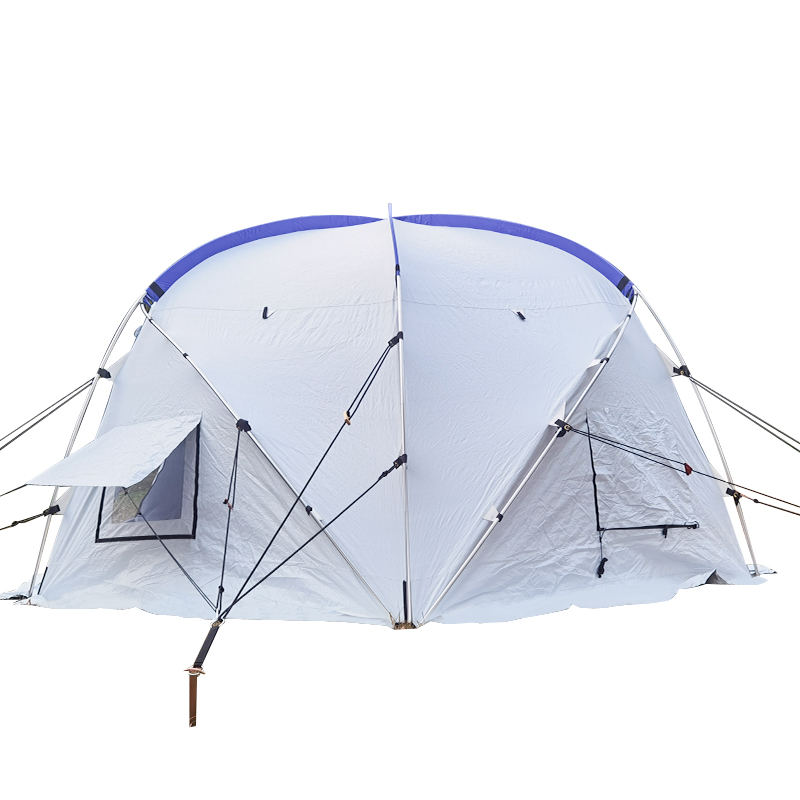
Inflatable tents serve four primary functions: rapid deployment (setup in 3-10 minutes), superior weather protection (withstanding winds up to 60 mph), exceptional portability (70% lighter than traditional frame tents), and versatile adaptability across commercial, recreational, and emergency applications. These air-supported structures replace conventional pole frameworks with high-pressure air beams, fundamentally transforming how temporary shelters are deployed in modern contexts.
Core Functional Mechanism: How Inflatable Tents Work
Unlike traditional tents relying on rigid poles, inflatable tents utilize air beam technology—durable TPU or PVC-coated polyester tubes inflated to 8-12 PSI. These beams create self-supporting structural arches that distribute stress evenly across the entire surface area.
Structural Components
Air Beams: Replace metal/fiberglass poles; deflate to compact 20%-30% of inflated size
Continuous Inflation System: Electric pumps maintain pressure automatically with backup battery options
Interconnected Chamber Design: Multiple air chambers prevent catastrophic collapse if one section punctures
The Heimplanet F6 Classic demonstrates this technology: its geodesic air frame supports 2,000+ lbs of snow load while packing to 23×17×13 inches—comparable to a large duffel bag.
Primary Function: Rapid Deployment and Strike
Time efficiency represents the most significant functional advantage. Setup duration decreases from 45-90 minutes (traditional 20×20 frame tent) to under 10 minutes for equivalent inflatable coverage.
Setup Time Comparison
Setup time comparison between tent types for 400 sq ft coverage
Tent Type
Personnel Required
Setup Time
Strike Time
Traditional Pole Tent
4-6 people
60-90 minutes
45-60 minutes
Frame Tent
3-4 people
45-60 minutes
30-45 minutes
Inflatable Tent
1-2 people
3-10 minutes
5-8 minutes
Military-grade inflatable command posts achieve 90-second deployment with integrated pump systems, enabling tactical mobility impossible with conventional structures.
Secondary Function: Environmental Resilience and Weather Protection
Inflatable tents demonstrate superior performance in extreme conditions due to their flexible structure and continuous tension distribution.
Snow Load: Geodesic designs support 30-50 lbs per square foot without structural failure
Thermal Performance: Double-wall construction achieves R-values of 4-6, reducing heating costs by 40% compared to single-layer tents
Waterproofing: PU5000mm+ coating exceeds industry standards for permanent water resistance
The Red Bull Storm Chamber project utilized inflatable structures in Antarctica's -40°F conditions, maintaining internal temperatures of 65°F with minimal energy input—demonstrating functional viability in the world's harshest environments.
Tertiary Function: Portability and Logistics Efficiency
Weight reduction of 60-75% compared to equivalent frame structures transforms transportation economics. A 20×30 inflatable event tent weighs 180-220 lbs versus 600-800 lbs for aluminum frame equivalents.
Transportation Advantages
Reduced Shipping Costs: Compact deflated volume (typically 4-8 cubic feet) enables standard parcel shipping rather than freight
Vehicle Accessibility: Fits in standard SUV cargo areas versus requiring box trucks for frame tents
Single-Person Mobility: Backpackable camping models like the Crua Core weigh 11 lbs and pack to 24×12×12 inches
Event rental companies report 35% reduction in fuel costs and 50% decrease in vehicle requirements after transitioning to inflatable inventory, with ROI achieved within 18 months.
Application-Specific Functions
Commercial and Event Deployment
Corporate activations leverage inflatable structures for brand immersion environments. The Igloo Vision 360° projection dome creates immersive experiences for 50-500 attendees, with 15-minute setup enabling same-day venue transitions.
Emergency and Medical Response
MSH Medical School Hamburg deployed inflatable emergency hospitals during COVID-19, achieving 100-bed field hospital setup in 4 hours versus 2-3 days for traditional modular structures. Key functional features include:
Positive-pressure HEPA filtration systems for isolation wards
Integrated climate control maintaining 72°F ±2° regardless of external conditions
Modular connection systems allowing unlimited linear expansion
Recreational and Extreme Environment Use
Mountaineering applications demonstrate functional reliability: the Heimplanet Mavericks base camp tent withstands Beaufort Scale 12 hurricane conditions at Everest Base Camp, where traditional tents fail at Scale 8-9 winds.
FAQ about Inflatable Tent Functions
How long do inflatable tents stay inflated?
Continuous-operation models run pumps 24/7 with 0.5-2 kWh daily consumption; sealed-beam designs maintain pressure for 3-7 days without power, requiring only 30-second top-offs.
What happens if an air beam punctures?
Multi-chamber construction isolates damage. Individual chamber failure affects less than 25% of structural integrity; repair kits enable field patching in 10 minutes with 90% strength restoration.
Are inflatable tents suitable for long-term installation?
Yes—semi-permanent installations operate continuously for 2-5 years. The Eden Project in Cornwall maintains inflatable biome structures since 2001, utilizing UV-resistant ETFE membranes with 30+ year lifespan ratings.
What is the maximum size for inflatable tents?
Current manufacturing limits extend to 100,000+ square feet single structures. The Saudi Arabia "Riyadh Season" inflatable pavilion covers 3.2 acres with 40-foot clear height, accommodating 15,000 concurrent visitors.
Do inflatable tents require constant power?
Not necessarily. Camping models use sealed beams requiring no power; event structures typically use 110V/220V pumps consuming 200-800 watts—equivalent to 2-8 incandescent bulbs. Solar/battery hybrid systems enable off-grid operation for 72+ hours.
Critical operational constraints for inflatable tent deployment
Factor
Limitation
Mitigation Strategy
Surface Requirements
Requires flat, debris-free ground
Ground sheets; site preparation protocols
Temperature Sensitivity
PVC becomes brittle below 14°F
TPU materials for cold climates; heating elements
Puncture Risk
Vulnerable to sharp objects
Protective ground layers; redundant chambers
Power Dependency
Continuous power for some models
Battery backups; sealed-beam alternatives
Initial cost premiums of 20-40% over traditional tents are offset by 60% reduction in labor costs and 5x faster deployment cycles over 3-year ownership periods.
Conclusion: Functional Superiority in Specific Contexts
Inflatable tents excel where speed, mobility, and weather resilience outweigh absolute cost minimization. Their functional profile aligns with:
Market growth projections indicate 8.3% CAGR through 2030, driven by military modernization and commercial event industry adoption—validating inflatable technology's functional transition from novelty to infrastructure standard.