

 English
 中文简体
中文简体 Español
 日本語
日本語 русский
 عربى
عربى

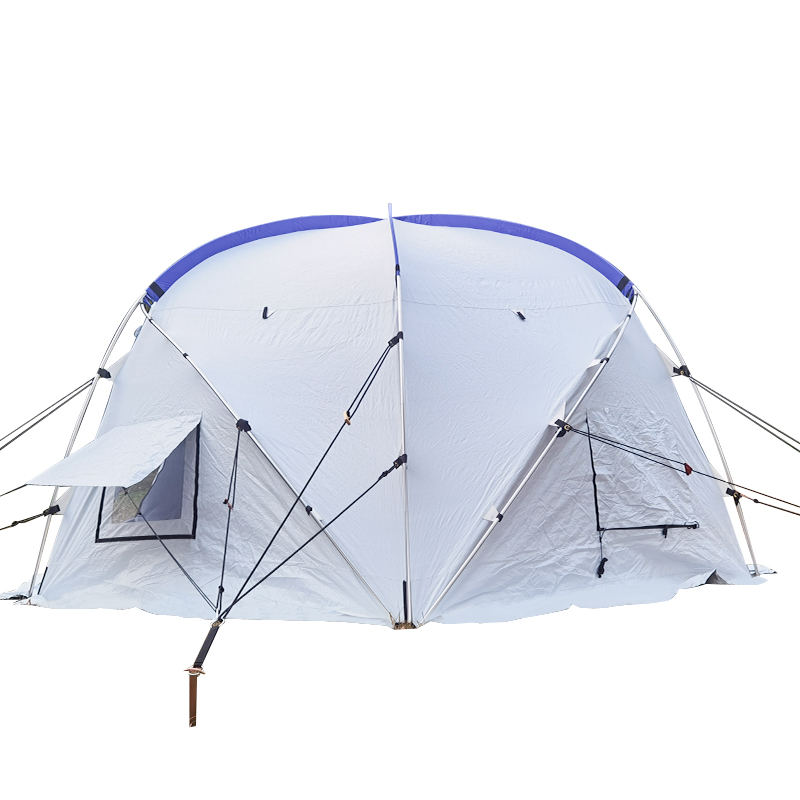


TO SHELTER ALL, TO SMILE ALL.
Our story is about how to uphold the spirit of humanitarianism in the face of disaster, how to find solutions amidst challenges, and how to sow hope in despair.
Content
You unroll your tent at the edge of a gravel-strewn campsite, and before the first peg goes in, the tent footprint vs tarp decision arrives. The floor of a shelter is its most vulnerable panel, exposed to sharp stones, pine needles, ground moisture, and repeated compression every night you sleep on it. If that thin layer of fabric fails, the puncture usually appears exactly where your sleeping pad meets the ground, and an afternoon of rain turns a minor tear into a soaked sleeping bag.
After manufacturing tents and tarps for more than two decades in our Jiangsu-based factory, our engineering team has seen hundreds of warranty claims where the root cause was not bad stitching but a missing or mismatched ground cloth. This article compares the purpose-made tent footprint against the generic camping tarp through the lens of actual field conditions: fit, material construction, packed weight, lifetime cost, terrain behavior, and simplicity of setup. The conclusion is not that one product is always superior, but that each has a clear zone of advantage.
For campers who want a one-step, no-measure, guaranteed-correct ground sheet, the tent footprint wins because it matches the exact outline of the tent floor. For campers who want multi-use utility and the lowest possible price, a tarp gives more coverage per dollar and doubles as a rain fly, sun shade, or gear wrap. By the end of this guide you will know which side fits your routine before the next trip is packed.
Key takeaway: the right ground cloth stops the first cause of tent floor failure before it starts, and the choice is decided by fit precision, terrain, and how many jobs the sheet must do.
A tent footprint is a purpose-cut sheet of waterproof fabric that matches the exact shape and dimensions of a specific tent model's floor. It sits between the tent floor and the ground and absorbs abrasion, punctures, and ground moisture before any of those threats reach the tent bathtub floor. Most footprints are made from 70D to 150D polyester or nylon with a polyurethane coating, weighing between 150 and 500 grams for a two-to-four-person shelter.
The defining feature of a footprint is that it mirrors the tent floor plan, including vestibule extensions and pre-cut stake loops. You simply spread it on the ground, and it aligns perfectly with the tent body's corners. This eliminates the two most common tarp mistakes: having the ground cloth stick out beyond the tent floor (which catches rain and channels water underneath) or leaving a section of tent floor exposed to debris because the tarp is folded too small.
From a purchasing standpoint, a footprint costs roughly 25 to 45 percent of the tent retail price, and it is designed to be used only with that tent. If you own one primary tent for family car camping, the footprint is the lowest-friction answer because no folding or measuring is required after the first setup. Many suppliers now sell tent and footprint bundles, which is a cost-effective way to enter this system; our factory, for instance, can pack a family tent, a matching footprint, and repair tape as a single stock-keeping unit for retail distribution.
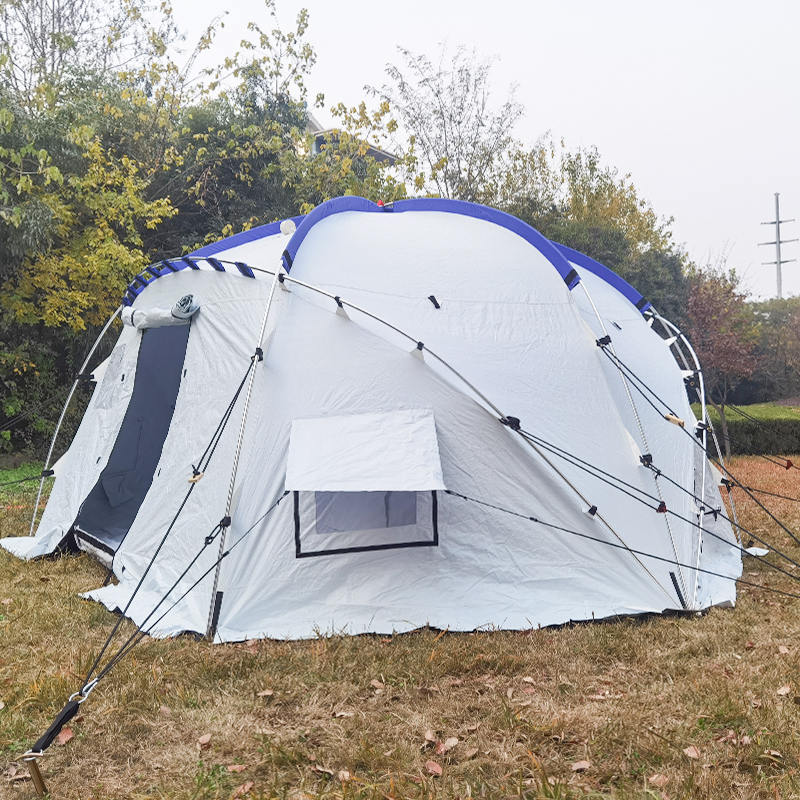 5-Person Self-Standing Geodesic Dome Family TentThis geodesic dome tent suits family car camping or rapid deployment, with a two-layer design and wind resistance up to 120 km/h. Its matched footprint keeps the floor sealed and simplifies campsite setup.View Product →
If the goal is long-term ownership of a single-family shelter, the footprint becomes part of the tent system rather than an accessory. A geodesic dome family tent, with its complex floor geometry and multiple vestibule anchor points, illustrates exactly why a matched footprint simplifies campsite life: every loop lines up, and the floor stays sealed.
Key takeaway: the tent footprint works best for a camper who owns one primary tent and values a no-measure, repeatable setup with the highest level of floor-matching protection.
A camping tarp is a rectangular, waterproof sheet made from polyethylene (PE), woven HDPE, PVC-coated polyester, or even cotton canvas, fitted with reinforced hemmed edges and grommets at regular intervals. Tarps are not engineered for one tent model. They are universal shelter fabric that can be laid flat under a tent, pitched as a rain roof, hung as a windbreak, wrapped around gear on a truck bed, or spread over a picnic table during a drizzle.
The strength of a tarp as a ground cloth is its margin of error. A standard 4 by 5 meter tarp costs a fraction of a branded footprint, and you can fold it to the exact shape of your tent floor in under a minute. If you later buy a larger tent, the same tarp is still useful because you simply unfold more of it. On rocky or root-covered ground, the thicker PE or PVC tarp provides a higher puncture threshold than a thin polyester footprint, which matters for base camp setups in alpine or desert terrain.
In our factory's production experience, the most durable ground-use tarps are 120 to 220 g/m² PE sheet with cross-laminated layers, or 450 to 650 g/m² PVC-coated polyester for industrial-grade scenarios. These materials tolerate UV exposure and repeated folding far better than budget tarps sold in mass retail. A quality tarp used as a ground cloth lasts three to five seasons, and the same tarp can switch between campsite jobs across those years.
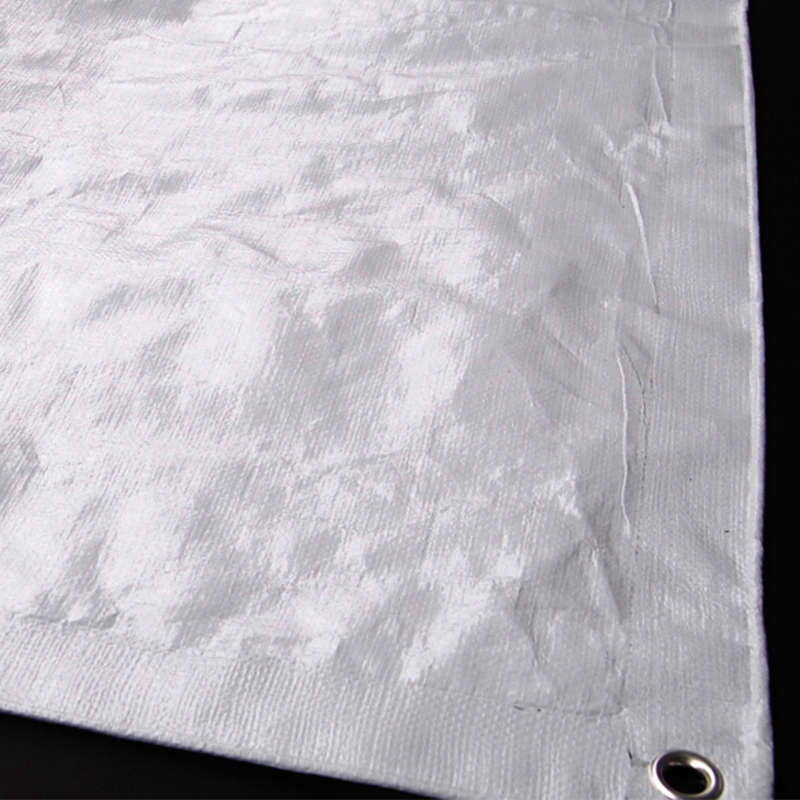 4x5m Reinforced HDPE Plastic Tarpaulin for Temporary ShelterA 20-square-meter reinforced PE tarpaulin with reinforced hems and grommets every 50 cm, ideal as a ground cloth or temporary roof. It tolerates UV and repeated folding, offering durable anchoring on uneven terrain.View Product →
A reinforced PE tarpaulin in the 4 by 5 meter format is the standard choice for relay campers in our catalogue because it covers a wide footprint area while remaining light enough to strap to a backpack. The reinforced hems and spaced grommets give you multiple anchoring options when the ground is uneven.
Key takeaway: the camping tarp delivers the best utility per dollar for campers who rotate gear, deal with changing group sizes, or want one fabric that protects the tent and also serves half a dozen other campsite functions.
When a procurement manager for an outdoor retail chain asks us how to advise customers on ground cloths, the answer starts with one table. The table below places the tent footprint and the camping tarp side by side across the criteria that matter most in the field. Keep in mind that material quality and thickness shift the numbers in either column, which is why specifications rather than product names should be the real basis of comparison.
| Criterion | Tent Footprint | Camping Tarp |
|---|---|---|
| Fit precision | Exact match to one tent model | Universal cover, must be folded or cut |
| Weight (2-person) | 180 to 400 g | 500 to 1,500 g depending on material |
| Typical cost for shelter area | USD 30 to USD 70 | USD 10 to USD 35 |
| Puncture resistance | Good to very good with PU-coated fabric | Low to high depending on PE/PVC thickness |
| Waterproofing | Coated polyester or nylon, 2,000 to 5,000 mm | PE/PVC sheets are inherently waterproof |
| Pack size | Slightly larger than a rolled shirt | Bulky when folded; needs compression strapping |
| Versatility | Single function for one tent | Awnings, wraps, windbreaks, emergency shelter |
| Setup time | Under one minute | Two to five minutes with folding and anchoring |
| Terrain tolerance | Best on prepared campsites and soft ground | Better on gravel, root-filled, and rocky surfaces |
| Lifespan expectation | 5 to 10 seasons with normal care | 2 to 5 seasons for PE; 5 to 10 for PVC/Canvas |
The table reveals a simple pattern: the footprint wins on weight, fit speed, and packability, while the tarp wins on versatility, raw puncture strength, and initial purchase price. Both products protect a tent floor well, but their design philosophies send them to different camper profiles. A backpacker counting every gram will almost always carry a tent-specific footprint; a family pulling into a drive-up campground can bring a heavier tarp, spend three minutes folding it, and enjoy the same protection plus a spare gear cover.
Key takeaway: compare material weight and thickness, not just the labels, because a heavy-duty PVC tarp and an ultralight footprint occupy opposite corners of the protection-versus-portability matrix.
The single most common ground-cloth failure is improper sizing. A footprint is cut to the exact tent floor outline, which means every corner sits in the right place and the sheet never extends past the rainfly drip line. A tarp, however, must be folded and positioned by hand, and this is where the tent footprint vs tarp decision first shows its real consequence.
When a tarp extends beyond the tent floor, rainwater slides down the rainfly, lands on the exposed tarp surface, and forms puddles that can wick under the tent. When a tarp is folded too small, the unprotected floor edges rub against rocks and roots. Correct tarp positioning requires the sheet to stay about 5 to 10 centimeters inside the tent's outer edge, which means measuring and folding before you place the tent body.
We measured the practical fit accuracy of several ground-cloth methods during a field test on a 3-meter-wide family tent, using the share of the tent floor that remained fully covered without excessive edge protrusion as the scoring metric. A purpose-made footprint scored at essentially full coverage, while a folded tarp required careful work to reach a similar level. The chart below compares the achievable fit quality of each solution after an average setup effort.
The takeaway from this comparison is that fit quality is largely a function of effort
Purpose-made footprints are pre-cut to each tent model's geometry
Cut-to-size tarps offer full control but need a one-time modification
Folded tarps occupy an intermediate position depending on user skill
Unfolded generic tarps create real risk on rainy nights due to edge runoff
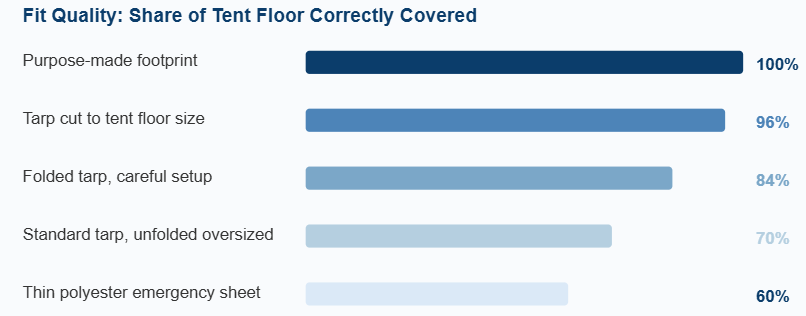
The horizontal bar chart shows that a purpose-made footprint achieves perfect geometric matching because the factory pattern is generated directly from the tent's floor plan. A tarp that has been cut to the tent floor size performs nearly as well, but the cut must be done cleanly, and you must remember to bring that specific folded tarp on every trip. A folded tarp without a cut line sits in the middle of the chart, reaching about 84 percent fit quality after careful positioning, while an unfolded generic tarp averages only 70 percent because of edge overhang and wrinkling.
The gap between 84 and 96 percent may sound modest, but it becomes decisive the moment it rains. A tarp that hangs 3 centimeters past the tent edge can channel several liters of water directly under the bathtub floor. On a windy site, the exposed tarp edge flapping in the breeze also pulls the fabric away from the ground and creates a gap for dust and insects to enter. Campers who use an unfolded tarp usually discover these problems on the first wet night and switch to a footprint or a pre-cut tarp right afterward.
If you choose the tarp route, take a permanent marker and draw the outline of your tent floor on the tarp surface, then fold along that line each time. This turns a generic tarp into a semi-custom ground cloth without any cutting or sewing. For a family tent with a peaked floor plan or multiple vestibules, however, the footprint will always beat a folded tarp because the complex outline simply cannot be reproduced by manual folding.
Another subtle dimension is the stake loop layout. Footprints have factory-positioned loops that mirror the tent's corner and vestibule anchors, so the ground cloth stays tensioned when you peg it down. A tarp's grommets are spaced every 50 to 100 centimeters, which rarely aligns with the tent's corners. Field users end up placing tent stakes through the tarp material, creating holes that enlarge over time and reduce the tarp's waterproof integrity.
Key takeaway: fit precision is not cosmetic; it is the first line of defense against rain pooling and floor abrasion, and the footprint's exact geometry gives it a durable advantage in wet climates.
The material of your ground cloth determines puncture resistance, waterproofing, UV durability, pack weight, and cost. When a wholesale buyer asks our supplier team which fabric to stock, the answer depends on the target customer and the typical terrain where the product will be used. Below is a breakdown of the most common materials used in both footprints and tarps, based on our factory's production data and industry-standard specifications.
Polyethylene (PE) film is the most common budget tarp material, available in thicknesses from 80 to 220 g/m², and is fully waterproof but prone to UV degradation after one or two seasons of heavy sun exposure. Woven HDPE adds a cross-laminate structure that improves tear resistance and makes the tarp suitable for rough ground. PVC-coated polyester is the premium tarp choice, using a welded or heat-sealed construction that reaches 500 to 700 g/m² and survives years of folding, UV, and freezing temperatures.
Polyester and nylon fabrics with polyurethane coatings dominate the footprint segment because they deliver the lightest weight and the most compact pack size, at the cost of lower absolute puncture resistance compared with thick PVC. Cotton canvas is a niche option for hot and dry climates: it breathes, resists sparks, and improves with age, but it absorbs water, becomes heavy, and must be completely dried before storage or mildew will develop.
The chart below shows the approximate material share among ground protection products currently marketed by outdoor suppliers
This distribution reflects both cost pressure at retail and performance demand from experienced campers
PE dominates entry-level tarps while PVC and HDPE compete at the mid and premium tiers
Footprint fabrics, represented within the PU-coated polyester segment, target weight-sensitive users
Canvas remains a small but dedicated category for traditional and glamping campsites
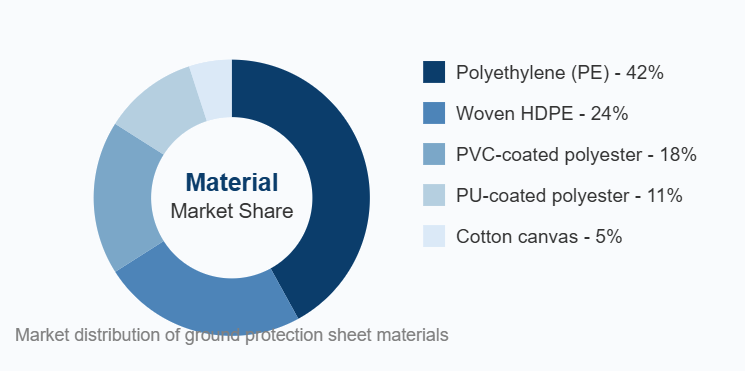
The donut chart reflects the broader outdoor retail market, where PE tarps represent the largest share because of their low price and household familiarity. Woven HDPE has grown steadily in recent seasons as buyers realize that the cross-lamination improves tear strength with only a moderate weight penalty. PVC-coated products occupy the premium tier, and their 18 percent share understates their value in the industrial and humanitarian sectors, where fire retardancy and long outdoor life are mandatory specifications rather than optional features.
For a tent footprint, the PU-coated polyester segment matters out of proportion to its modest 11 percent market share. These fabrics achieve a hydrostatic head of 3,000 to 5,000 millimeters, which is more than adequate for ground moisture, while remaining light enough to be packed inside a compression sack. The trade-off is that PU coatings can hydrolyze over several years, especially in humid storage conditions, so a footprint should be dried before long-term packing.
Canvas, at 5 percent, is a specialty choice found mainly in outfitter tents and luxury glamping setups. A canvas tarp placed under a canvas tent maintains a consistent aesthetic and handles sparks from a campfire safely, but the material demands more care: it must be brushed clean and dried thoroughly, and it becomes significantly heavier when wet. For ordinary weekend camping, PE or PVC tarps offer the best balance of durability and maintenance simplicity.
When selecting between materials, we recommend checking three numbers: basis weight in grams per square meter, hydrostatic head in millimeters for coated fabrics, and the UV stabilizer concentration that the converter added to the PE or PVC formulation. Tarps without UV stabilizers will become brittle and crack after two summers of direct sunlight, while properly stabilized sheets retain flexibility after five years of exposure. These specifications matter for procurement managers placing large wholesale orders, as the difference between a 120 g/m² and a 180 g/m² PE tarp can mean the difference between a two-season and a four-season product.
Key takeaway: match the material weight and coating chemistry to your real campsite conditions, not to the cheapest shelf price, because UV stabilizers and fabric weight are the two factors that determine how many seasons a ground cloth survives.
Backpackers measure every gram because a long approach trail makes weight feel magnified at the end of the day. A typical two-person tent footprint weighs between 180 and 400 grams and compresses to the size of a water bottle. A comparably sized PE tarp starts at 500 grams for a flimsy 120 g/m² sheet and exceeds 1.5 kilograms for a 220 g/m² reinforced utility model, which is a massive penalty when every liter of pack volume is already allocated.
Pound-for-pound efficiency explains why footprint adoption is highest among thru-hikers and ultralight enthusiasts. These campers do not need a multi-purpose tarp because they are already carrying dedicated rain gear and their tent design handles its own waterproofing. The footprint's single job is to prevent the floor from abrading against the ground, and it does that job at the lowest possible weight.
Car campers and family groups, in contrast, drive their gear to the site and can afford the extra kilograms of a tarp. The same 4 by 5 meter tarp that protects the tent floor can also be pitched as an afternoon shade or draped over an outdoor table during a rainstorm. This dual-use factor often justifies the weight for families who spend long weekend afternoons at the campsite rather than hiking to a new location each day.
Medium-weight options, such as a 160 g/m² woven HDPE tarp of 3 by 4 meters, offer a compromise: about 900 grams packed weight, better puncture resistance than a footprint, and enough flexibility to cover a couple of outdoor functions. This type of product sits in an expanding market niche that has grown as hybrid car-camping and short-trail backpacking blur together.
Key takeaway: if your base weight budget is strict, the footprint compresses to a negligible addition, while the tarp's versatility only pays off when transport weight is not the limiting factor.
Price comparison between tent footprints and tarps is rarely a fair one because the products serve different roles. A branded footprint for a premium tent can cost USD 50 to USD 90, while a mass-market PE tarp of the same flat area costs USD 10 to USD 25. That stark difference drives many first-time buyers toward the tarp, but a complete cost analysis must include lifespan, replacement frequency, and the cost of the tent floor damage that each product prevents.
A carefully used footprint can outlive two or three tent bodies because PU-coated polyester is protected from direct sunlight by the tent itself; it only sees UV at the edges. A budget PE tarp, by contrast, degrades in sunlight even when stored, because the film's plasticizers evaporate over time. Campers who leave a cheap tarp out for an entire season will usually throw it away the following spring.
From our factory records, a quality PVC-coated tarp in the 500 to 650 g/m² range has a practical outdoor life of five to eight years, which brings its annualized cost close to that of a footprint and far below repeated cheap tarp replacements. This is why the tent footprint vs tarp discussion among procurement professionals always centers on the total cost of ownership, not the shelf price.
The cumulative cost chart below tracks three realistic ownership scenarios over five years
A premium footprint purchased once at USD 50 with no further expense
A heavy-duty PVC tarp purchased once at USD 35 with no replacements
A budget PE tarp replaced annually at USD 12 per sheet
The chart reveals how cheap initial purchases become expensive by year three
All figures are based on current wholesale and retail price ranges in the US market
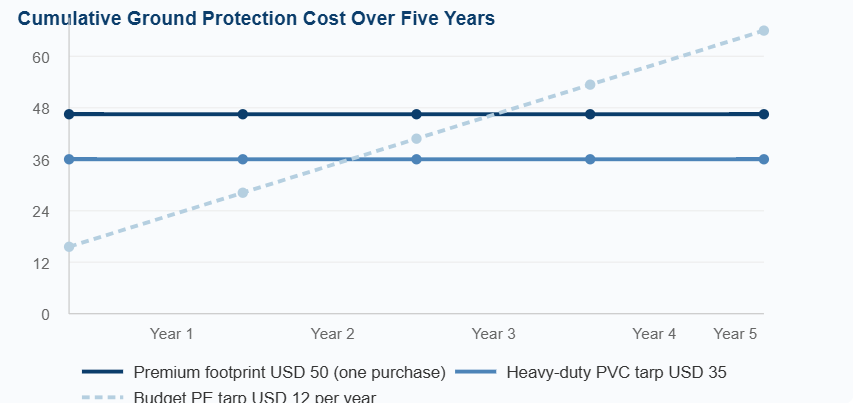
The line chart tells a decisive story for budget buyers. The constant flat lines for the footprint and the PVC tarp reflect the fact that both are single purchases with a long useful life, while the rising dashed line for the budget PE tarp crosses the USD 36 point by year three and reaches USD 60 by year five. By the end of the five-year period, the annual replacement strategy has cost 20 percent more than the premium footprint and 70 percent more than the heavy-duty PVC tarp, while offering the lowest puncture resistance and the lowest user satisfaction in wet conditions.
The analysis changes when the tarp is doing additional work beyond ground protection. If the same tarp serves as a rain awning during summer thunderstorms and wraps sports gear on the drive home, its effective cost is shared across multiple functions. In that case, even a budget PE tarp can be economically rational for a car camper who does not need maximum floor protection. A footprint, by contrast, offers zero secondary function, so its entire USD 50 cost must be justified solely by floor protection.
Wholesale buyers should apply the same logic at pallet scale. A retail chain that purchases 500 footprints for a specific tent line will sell them at a healthy margin because the consumer has no alternative but to match the tent model. A chain that carries generic tarps instead competes against hardware stores and supermarkets on price. This is why many of our wholesale customers choose to bundle a tent and footprint into one package: the bundle increases perceived value while reducing the consumer's decision complexity.
For the individual camper, the cost decision comes down to one question: will the ground cloth double as something else? If yes, the tarp wins on value. If no, the footprint wins on both lifetime cost and long-term floor protection.
Key takeaway: the cheapest price tag is rarely the cheapest ownership cost, and a mid-priced footprint or PVC tarp usually beats annual tarp replacements after the third season.
The best ground cloth depends heavily on the surface you will sleep on, and the tent footprint vs tarp ranking flips depending on the landscape. On a manicured grassy campsite at an organized campground, both options perform well, and the footprint's convenience wins because setup is instantaneous. On a rocky mountain shelf, a thicker tarp offers more puncture resistance than a thin footprint, even if the footprint was included with the tent originally.
Rain is the other major variable. In dry conditions, any tarp edge that sticks out is merely a nuisance; in wet conditions, it becomes a plumbing problem. If you expect heavy rain, the ground cloth must stay smaller than the rainfly footprint, which is exactly how a footprint is designed. With a tarp, this requires disciplined folding and placement each night, and any mistake is punished with water pooling inside the tent vestibule.
The table below summarizes the terrain and weather scenarios we have encountered across our factory's field-testing program, with a recommendation for each.
| Campsite Condition | Recommended Ground Cloth | Rationale |
|---|---|---|
| Grassy campground, car camping | Footprint | Fast setup, exact fit, no edge pooling risk |
| Rocky or root-covered soil | PVC or heavy PE tarp | Higher puncture threshold below the tent floor |
| Sand and beach sites | Footprint or PE tarp | Sand drains well; either option works, tarp needs extra anchoring |
| Snow camping | Canvas or thick PE tarp | Adds insulation layer between snow and tent floor |
| Heavy rain forecast | Footprint | Precision fit prevents water channeling under the tent |
| High UV desert exposure | UV-stabilized PVC tarp | Withstands direct sun far better than PU-coated fabric |
Desert campers face a unique hazard: UV radiation attacks the polymer structure of footprints and cheap tarps during the day, then cold night temperatures make the polymer brittle. A UV-stabilized PVC tarp rated for outdoor industrial use is the safest choice in this environment. In contrast, snow camping changes the calculation because a layer of insulation under the tent matters as much as abrasion protection; a rigid foam pad or a folded canvas tarp provides both in one package.
Key takeaway: read the campsite first, then choose the ground cloth; rocky, snowy, and desert sites favor thicker tarp materials, while grassy campgrounds and wet weather favor the footprint's exact geometry.
Using a tarp under a tent is a skill that any camper can learn in five minutes, and doing it correctly removes most of the disadvantages listed earlier. The goal is to reproduce, as closely as possible, the fit precision of a purpose-made footprint using nothing more than a rectangular sheet and a few extra stakes. Below is the procedure we recommend in our practical technical manual for camping tents.
Many campers ask whether the tarp should be exactly the size of the tent floor or slightly smaller. Our testing on a 4-person pole tent showed that a tarp 5 to 10 centimeters smaller than the floor plan performed identically to a footprint in dry conditions, and even slightly better in heavy rain because the reduced surface area eliminated all edge pooling. Going smaller than 10 centimeters, however, exposed the tent floor to abrasion along the perimeter.
For long-term use, draw a permanent outline on the tarp using a marker and fold along that line every time. This eliminates the decision-making step and turns a generic tarp into the functional equivalent of a footprint at a fraction of the cost. We recommend adding a small loop of tape or a repair patch at each approximate stake location so that the tarp can be tensioned without puncturing the main fabric in a different spot each time.
Key takeaway: a tarp becomes a reliable footprint substitute when you fold it 5 to 10 centimeters smaller than the tent floor, pin it at the corners, and inspect for visible edges before every rain risk.
Different camping styles create different demands on a ground cloth, so the right answer for a thru-hiker is unlikely to be the right answer for a family of five. The guide below matches camper profiles to the best ground cloth option, and it is the same framework our sales team uses when assisting wholesale customers who are building product assortments.
| Camper Profile | Best Choice | Why |
|---|---|---|
| Thru-hiker / ultralight backpacker | Matching tent footprint | Minimum weight, exact fit, no secondary use needed |
| Weekend car camper | Folded PE or PVC tarp | Low cost, multi-use, transport weight not a concern |
| Family campground regular | Footprint or bundle | Fast setup with kids, consistent protection for a single tent |
| Glamping / canvas tent owner | Canvas tarp | Matches aesthetic, handles fire sparks, breathable base layer |
| Adventure motorcyclist | Cut-to-size HDPE tarp | Durable against rough storage, also serves as roll wrap |
| Emergency / disaster preparedness | Heavy-duty PVC tarp | Multi-purpose shelter fabric, long UV life, fire-retardant options |
The camper profile table highlights a broader pattern: the more specialized the trip, the more a matched footprint makes sense; the more generalized the gear and the longer the vehicle stay, the more a tarp earns its place. There is also a middle path that many experienced campers adopt, carrying a footprint for the tent and a small 2 by 3 meter tarp for camp duties. This dual-carry strategy adds about one kilogram but delivers the best of both worlds in most conditions.
Key takeaway: match the ground cloth to the trip philosophy, not to a marketing claim; dual-carrying a lightweight footprint and a small utility tarp covers nearly every scenario.
A ground cloth is an easy piece of gear to neglect because it sits outside the tent where nobody inspects it on a daily basis. Routine maintenance determines whether a footprint lasts five seasons or ten, and whether a PE tarp degrades after one winter or survives four years of camp use. The steps are simple and apply to both products with only minor differences.
After each trip, shake the ground cloth free of sand, pine needles, and sharp debris before folding. At home, wash it with mild soap and water if mud has dried onto the surface, and pay attention to the folds: dirt trapped inside a fold acts as an abrasive and can wear through the coating over time. Hang the cloth to dry completely, because storing it wet accelerates polymer hydrolysis and provides a breeding ground for mildew.
Inspect the edges and grommets for tearing or elongation. A torn grommet can be repaired with a patch kit, but a footprint's stake loops, which are sewn or welded into the fabric, should be checked at the seam where they meet the sheet body. If a seam starts to fray, applying a seam sealer or a patch of repair tape adds another season of life.
UV protection is the single biggest factor in ground cloth longevity. When you reach camp, orient the tent so that the rainfly shades the ground cloth edges, and never leave a tarp stretched in direct sunlight when it is not providing cover. For PE tarps, folding them into a bag when not in use blocks the UV exposure that would otherwise occur at the campsite, because UV degradation continues even under overcast skies.
Storage conditions matter as much as field care. Keep both footprints and tarps in a dry, cool place away from direct sunlight, ideally in a breathable cotton bag rather than an airtight plastic sack. If the fabric develops small holes, repair them immediately with adhesive-backed nylon tape rather than sewing, because needle holes can propagate across coated material.
Key takeaway: five minutes of cleaning and drying after each trip, plus a UV-conscious camp setup, will double the service life of any ground cloth product.
When an outdoor retailer, NGO, or government procurement agency evaluates ground protection products, the decision is never about one unit; it is about hundreds or thousands of units that must perform consistently across one production batch. From our position as both a factory and an international trade enterprise, we build tents and tarps that are specified by material weight, hydrostatic head, seam construction, and fire-retardant certification, because these documents become the contract between supplier and buyer.
The manufacturing process for a high-quality PE or PVC tarp starts with the fabric itself: a woven base scrim that carries the tensile load, coated with a formulated polymer that provides waterproofing and UV stabilization. The most durable tarps use a double-sided coating with a cross-laminated structure, followed by heat-sealed hems and rust-proof grommets spaced at regular intervals. Every one of these parameters is measurable and testable, which is why wholesale buyers can rely on material data sheets rather than promotional language.
For tent footprints, our production team cuts the pattern directly from the tent floor CAD file, so the footprint outline matches the tent's corners, vestibule extensions, and pole anchor points precisely. We use 120D to 200D polyester with a 3,000 to 5,000 millimeter polyurethane coating, and we ultrasonically weld the stake loops instead of sewing them, which eliminates needle holes from the critical tension areas. These details matter when a footprint is ordered as part of a complete tent kit for humanitarian projects, where field reliability is a matter of public safety rather than personal comfort.
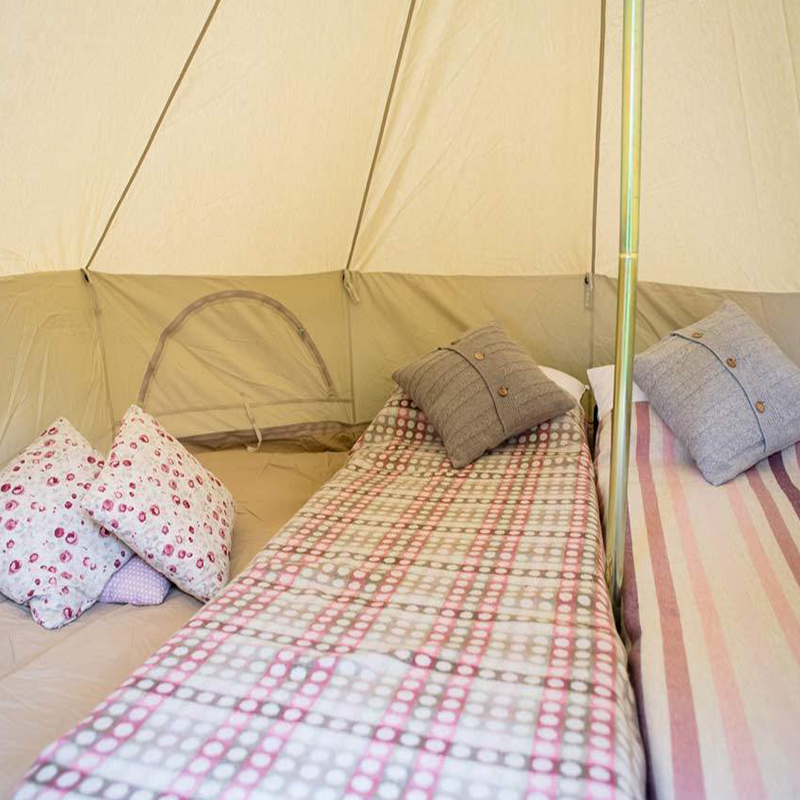 3m Waterproof Cotton Canvas Bell Tent with AccessoriesThis 3-meter bell tent uses sturdy cotton canvas, includes windows, screen doors, and vents for airflow, plus stakes and poles. It offers interior pockets and hanging loops, making it a comfortable choice for family or friend camping.View Product →
Wholesale customers can combine tents, tarps, footprints, and related core relief items such as sleeping mats and blankets into a single logistics order. Our factory supports OEM customization of colors, sizes, label printing, and packaging, and we can apply fire-retardant treatments that meet NFPA 701 or similar regional standards. Whether you are retailing a complete camping line or stocking emergency shelter kits, the anchor point is the same: a ground cloth that sits flat, seals water, and survives repeated use without delamination.
Key takeaway: for volume buyers, the material specification sheet and seam construction method matter more than the product name, and a reliable factory partnership ensures consistent quality across every production batch.
Is it worth getting a tent footprint if I already own a tarp?It depends on the terrain and the weather you typically encounter. If you camp on grassy prepared sites and pack light, the footprint is worth its modest weight because it fits instantly and never channels water. If you camp on rocky or rough ground, a thicker tarp offers better puncture resistance, and the footprint purchase can be skipped. The decision matrix in this guide rates the footprint highest for fit speed and wet-weather safety, while the tarp wins on multi-use value. |
Can I use any tarp as a tent footprint?Yes, as long as the tarp is folded or cut so that its edge stays inside the tent floor plan. The key is avoiding overhang, which catches rain and guides it under the tent, and avoiding excessive undersize, which exposes the floor perimeter to abrasion. The recommended margin is 5 to 10 centimeters smaller than the tent floor. A PE or PVC tarp with reinforced hems works best; an old cotton drop cloth fills the same role in dry climates but becomes too heavy when wet. |
Should a tent footprint be larger or smaller than the tent?It should match the tent floor outline exactly if it is purpose-made, or be 5 to 10 centimeters smaller if you are using a tarp. A footprint that extends past the rainfly edge collects water and defeats the purpose of the bathtub floor design. If you purchase a universal footprint or make your own from a tarp, trace the tent floor outline on paper, transfer it to the sheet, and cut with a margin of minus 5 centimeters on all sides. |
How do I stop water from pooling under the tent when using a tarp?Pinch the tarp inward beneath the tent body so that the edge lies inside the rainfly line at every point around the perimeter. Next, ensure the ground has a slight slope away from the tent center so runoff can escape. Finally, avoid stretching the tarp taut over a hollow, because the depression will fill like a bowl when rain flows toward the lowest spot. A footprint eliminates all of these concerns because its geometry is already set by the factory. |
Do I need both a footprint and a tarp on a camping trip?Not always, but the combination is common among car campers and base-camp groups. A footprint protects the tent floor, while a separate 3 by 4 meter tarp serves as an awning over the camp table or a rain fly over a gear storage area. Backpackers rarely carry both because weight matters more. If you plan multi-day trips with stationary camps, the combined setup adds comfort without substantial burden. |
How long does a tent footprint or tarp ground cloth last?A quality PU-coated footprint lasts five to ten seasons when dried and stored correctly, because the tent shades it from UV during use. A woven HDPE or PVC-coated tarp lasts three to eight years depending on material weight and sun exposure. Budget PE tarps without UV stabilizers typically survive one to two seasons before becoming brittle, which means their low price is offset by frequent replacement, as shown in the cost analysis chart earlier. |
Key takeaway: in most ownership scenarios, the true cost difference between a footprint and a tarp is small over five years, so choose based on fit preference and campsite terrain rather than price alone.
The ground cloth is only one layer of a well-planned camp setup. For a deeper understanding of how the tent interacts with the ground, the poles, and the weather, the following resources from our factory's camping tent collection and technical library are a useful next step.
| Resource | What You Will Learn |
|---|---|
| Practical technical manual for camping tents | Pole structure, fabric selection, ventilation, and long-term care for camping tents across all seasons. |
| Camping tent product range | Browse family tents, backpacking tents, canvas bell tents, and inflatable models with full specifications. |
| Inflatable camping tents | Learn how air-beam structures change the setup process and when an inflatable tent suits group camping. |
The links above are maintained by our team and lead to pages with material details and dimensional drawings that are useful for comparing products before purchase.
When the tent footprint vs tarp question is settled by field logic, the answer has three parts. First, if you own one tent, camp mostly on grassy or prepared sites, and want the fastest and most foolproof setup, buy the matching footprint from the tent manufacturer and keep it with the tent body in the same storage sack. Second, if you camp on rocky terrain, drive to the site, and want one sheet that handles ground protection plus awnings and gear wraps, choose a quality PE or PVC tarp and fold it 5 to 10 centimeters smaller than the tent floor. Third, if you fall between these profiles, carry both: the footprint under the tent and a small tarp for camp duty.
The data in this guide confirms that neither solution is obsolete and that the best purchase is the one matched to your trip frequency, terrain, and willingness to spend minutes on setup details. The real protection does not come from the product name; it comes from the material specification, the fit precision, and the care you give the sheet between trips.
At Mailenda, we manufacture both tents and tarps on the same factory line, and we know from testing that every construction detail, from seam type to grommet spacing to UV stabilizer dosage, influences how well a ground cloth performs in the field. We invite wholesale buyers, retail chains, and institutional procurement teams to contact us for material data sheets, samples, and custom specification support.
Key takeaway: buy the type of ground cloth that matches your dominant campsite condition, and keep the tent floor dry and clean to get the longest service life from your shelter investment.
Related Products

Our story is about how to uphold the spirit of humanitarianism in the face of disaster, how to find solutions amidst challenges, and how to sow hope in despair.
Copyright © Yangzhou Mailenda Outdoor Products Co., Ltd.
All Rights Reserved.
Custom Tent OEM/ODM Manufacturers


