

 English
 中文简体
中文简体 Español
 日本語
日本語 русский
 عربى
عربى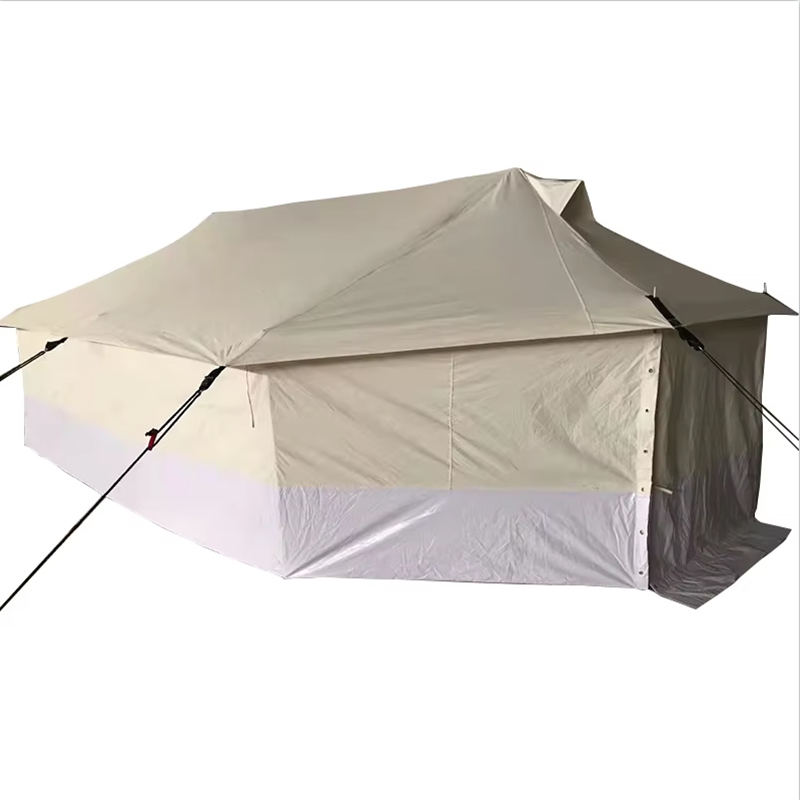



TO SHELTER ALL, TO SMILE ALL.
Our story is about how to uphold the spirit of humanitarianism in the face of disaster, how to find solutions amidst challenges, and how to sow hope in despair.
Content
The first time a pop up tent refuses to go back into its bag, it is almost never a strength problem. It is a sequence problem. If you learn how to fold up a pop up tent in the order the frame wants to move, a 3 x 3 m canopy that took two people ten minutes last weekend will close in two, and the poles will still be straight next season.
Picture the end of a school fete. The wind has turned, rain is twenty minutes away, and four adults are holding down a canopy that folded perfectly at the factory. Someone pushes a corner down. The frame creaks and stops. Someone else pulls a leg outward. Still nothing. The tent ends up in the van half-collapsed, with one bent strut and a torn fabric sleeve.
The short version: identify your frame type, release the lock instead of forcing it, and fold the fabric in the direction the struts dictate. Canopy frames fold down, camping pole frames fold around themselves, canvas tents fold flat. Everything below explains those three motions step by step, along with the preparation most people skip, the mistakes that cost the most money, and the checks that wholesale buyers and tender teams should run before ordering pop up tents by the container.
Pop up tents share one promise, which is speed of opening. They do not share a folding motion. Trying to fold a pre-bent pole dome the way you fold a gazebo is the fastest way to kink fiberglass, and trying to twist a scissor canopy into a circle will simply bend the roof bars. There are three families worth knowing before your hands touch the frame.
Gazebos, pagodas, folding market stalls and most party canopies use a scissor frame. Each leg telescopes, and a sliding collar with a spring pin locks the leg at working height. Roof struts cross in an X pattern between the legs and the centre, which is why the roof pulls inward as the legs shorten. The cover is normally fixed to the frame permanently, so it is never removed; it gathers.
Camping pop up tents, often sold as instant tents, use fiberglass or steel poles that arrive already curved. A hub or a crossing pair of poles holds the roof open. This type is not collapsed leg by leg. It is flattened, folded in thirds and twisted around itself until the poles form a circle roughly the size of a large serving tray.
Inflatable shelters have no folding frame at all. You release the air from the beams through the valves, then fold or roll the skin along the creases it already has. The discipline here is the opposite of a canopy: you want the shelter flat and dry before it goes anywhere near a bag, because a half-inflated beam is easy to crease permanently.
| Tent type | What holds it open | Folding action | People needed | Most common damage |
|---|---|---|---|---|
| 3 x 3 m scissor canopy | Telescopic legs with spring pins and X roof struts | Collapse legs in pairs, then gather the cover into pleats | 2 | Fabric sleeve torn at the collar |
| 6 x 6 m pop up pagoda canopy | Heavy-duty leg collars and reinforced roof bars | Same motion, but in a fixed walking order around the frame | 3 | Bent roof bar caused by single-person folding |
| Instant dome camping tent | Pre-bent fiberglass poles and a roof hub | Flatten, fold in thirds, twist into a circle | 1 | Split pole close to the hub |
| Inflatable shelter | Low-pressure air beams | Deflate, fold flat, roll toward the valve | 2 | Sharp creases along the beam seam |
Commercial canopies are the easiest place to see the logic, because the shape is symmetrical and the order is visible from outside the frame. A good example is our 6 x 6 m pagoda marquee with a 2.3 m side height, a PVC pop up canopy built on four locking collars with a fixed roof cover. The steps further down this page match exactly how that model behaves when a crew of three breaks it down at the end of an event.
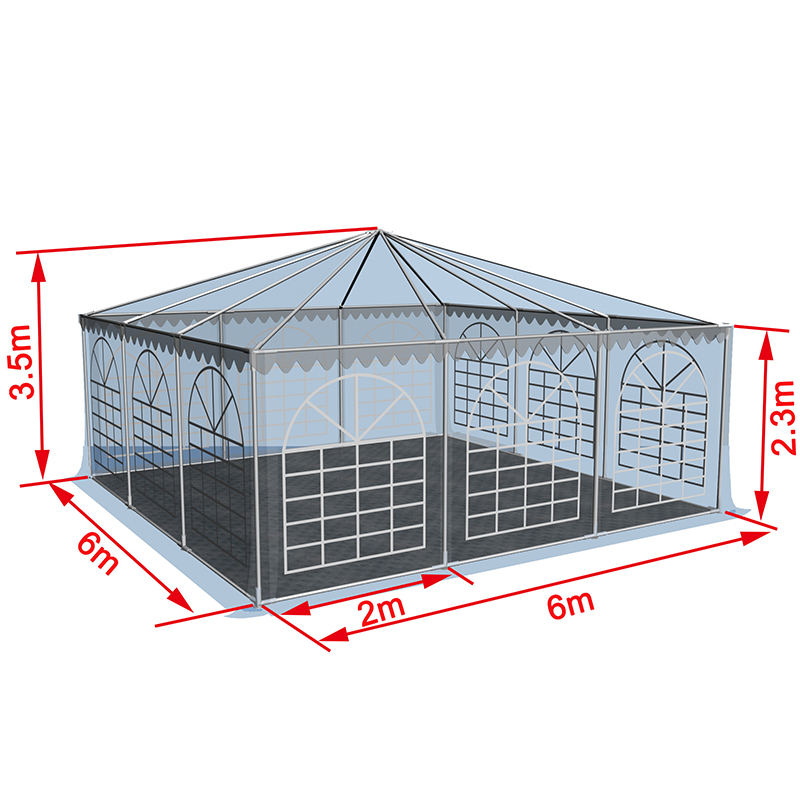 6x6-2.3m Pagoda Marquee PVC Pop Up Canopy TentWhether it is a wedding party, birthday party, community activity, club gathering, or market exhibition, this 6x6m pagoda marquee PVC pop-up canopy tent is suitable an...View Product →
Most bent frames come from forcing a locked collar, so identify the frame type before you apply any pressure at all.
Folding is a two-person job above 3 x 3 m, and a slow, awkward job if the tent is still pinned, loaded or wet. The preparation list below is the part crews skip when they are tired, and it is the part that decides whether the tent opens cleanly next time.
Work through these points before you release a single lock:
Two of these steps matter more than the rest. Grit is the quiet killer of PVC and PE coatings, because every fold presses the same particles into the same line. Moisture is the loud killer, because mildew stains and smells do not wash out of coated fabric once they have set. If you only have time for two preparation steps, brush the underside and get the roof dry.
Never fold a pop up tent while it is wet or sandy; that single habit shortens the working life of the cover more than any other mistake.
This is the sequence for a scissor-frame canopy: gazebos, pagodas, folding market halls and most party canopies. The frame does the work. You are only guiding it.
One person can fold a 3 x 3 m canopy. Lay the frame on its side, release one leg at a time while kneeling on the outside of the cover, and rotate the canopy as each leg closes. On anything from 5 x 5 m upward, work with two people. The reason is not strength, it is leverage: an unsupported 6 m roof bar takes the whole weight of the cover at a single point when it drops, and that is where bends start.
Release the lock, lower the leg, let the struts pull the roof in, then gather fabric into straight pleats: that order is the whole technique.
Instant camping tents behave differently from canopies, and the fold is closer to a twist than a push. The poles are pre-bent, so they want to return to a curve, not a straight line.
Three details keep poles alive. First, never bend a fiberglass pole into a sharp angle; it will hold the kink even after it relaxes. Second, if a fiberglass pole splinters, wrap the split with tape before handling it and keep your hands away from the frayed edge. Third, if a pole does not want to close, stop and check the hub, because a pole that has slipped out of its sleeve will never twist into place.
Small dome models are the easiest to practise on, because the pole arcs are short and the fabric is light. Our 2.4 x 2.4 m waterproof ripstop polyester canvas dome backpacking tent uses exactly this fold, and the packed circle fits back into the supplied bag without forcing. Practise the twist twice on a dry day in the garden and the motion becomes automatic.
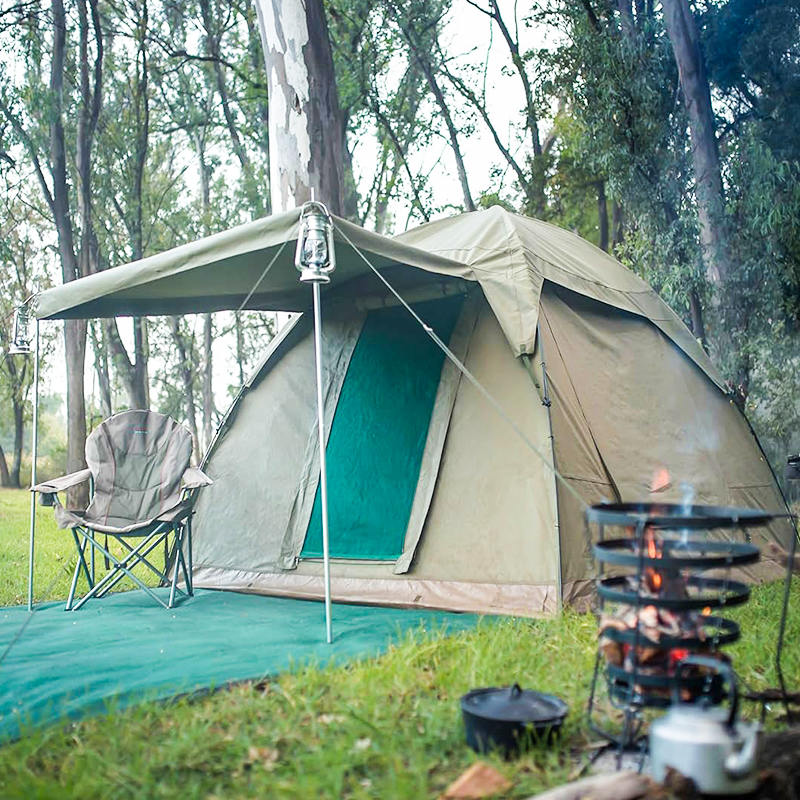 2.4x2.4m Camping Waterproof Ripstop Polyester Canvas Dome Backpacking TentThis 2.4m × 2.4m canvas dome backpacking tent is made of 320gsm waterproof ripstop polyester canvas, which is durable and weatherproof and can accommodate up to 4 peop...View Product →
Classic canvas tents are not pop up models, and they should never be twisted. Peg them out flat, fold the canvas in panels the way it came folded from the supplier, and roll it around the pole bundle. If you twist heavy cotton canvas, you create permanent crease lines that weaken the waterproofing along those lines. Fold flat, roll once, store loose.
A pop up camping tent is twisted into a circle, while a canvas tent is folded flat and rolled; mixing the two methods damages both.
Most crews blame themselves for being slow, when the real difference is tent type and how many people are working. The numbers below are working ranges we see again and again in field use, from single-person camping shelters to commercial canopies.
Treat them as targets rather than rules. A tent that takes noticeably longer than these figures usually has a trapped fabric panel, a partially locked collar or a pole that has slipped out of its sleeve.
Typical fold-down time after use, by tent type
The pattern here is useful for anyone running a rental fleet or a relief logistics operation. Small camping domes are quick because there is only one person involved and no coordination cost, which is why instant dome tents remain popular with individual campers. Large commercial canopies take longer mainly because of fabric area: a 6 x 6 m cover has roughly four times the surface of a 3 x 3 m cover, and every extra square metre has to be pleated by hand.
That is also why our larger pop up canopies are built with a fixed cover and reinforced roof bars rather than a removable skin. Removing and refitting a large PVC cover adds several minutes to every pack-down, and it introduces the risk of creasing the material against the frame. A fixed cover that gathers into pleats keeps the same fold line every time, which is easier on both the fabric and the crew.
For five-person family models, the foldable design is deliberate. A tent that folds down along marked lines takes about four minutes for two people, and it can be packed by one person in a hurry, which matters in a relief camp where the same shelter has to be moved between locations. Consistency of pack-down time is often worth more to an organisation than a slightly faster open-up time.
If a fold is taking far longer than the range above, the problem is almost always a trapped panel or a locked collar, not the size of the tent.
The same handful of faults account for nearly every tent that will not go back in its bag. The table below lists the symptom, the usual cause and the fix that costs nothing.
| Symptom | Usual cause | Correction |
|---|---|---|
| Leg will not slide down | Spring pin still engaged, or the leg is twisted in its collar | Rotate the leg until the pin clicks, then release |
| Roof stays high in the middle | Roof strut is locked against its hinge or a sidewall is still attached | Remove add-on panels, then lower legs one pair at a time |
| Bundle too fat for the bag | Fabric folded in spirals instead of long pleats | Open out, shake, and re-fold into straight pleats |
| Tent will not lie flat | Door zipped shut, so air is trapped inside | Open every zip before flattening |
| Pole will not twist into a circle | Pole has slipped out of its sleeve or the hub | Re-thread the pole before bending anything |
| Sharp bend in a fiberglass pole | Forced fold at too tight an angle | Relax the pole, tape any splinter, fold on a wider radius |
| Damp smell in storage | Tent packed wet and left compressed | Dry fully in shade, store loose, never in a hot vehicle |
Two of these deserve extra attention. Trapped air is the most underrated problem, and it is solved by a zip. Fabric spiralling is the most common cosmetic complaint, and it is solved by slowing down for thirty seconds at the gathering stage. Neither requires parts, tools or replacements.
The one fault that does require a decision is a bent or split pole. A single replacement leg or pole section is a cheap repair; a bent roof bar that has been straightened by hand will never sit square again, and it throws the whole frame out of alignment on the next open.
Replace a damaged pole instead of straightening it, because a repaired bend keeps pulling the frame out of square every time the tent opens.
Storage decides whether the next set-up takes two minutes or twenty. A tent that has been compressed wet in a hot vehicle for six months will smell, stain and stick to itself when it is finally unrolled.
Refolding along slightly different lines once a year is not a waste of time. It spreads the stress on the coating and avoids one crease becoming a crack over several seasons, which is particularly relevant for PVC covers on commercial canopies that are packed and unpacked weekly.
Compression is for transport and ventilation is for storage; a tent stored loose in a dry room will always fold faster than one stored crushed in a bag.
When pop up tents are bought in volume, the folding behaviour becomes a specification issue rather than a user issue. Rental fleets, retail chains, importers and humanitarian procurement teams all ask the same questions in a different order, and the answers depend on the frame and fabric rather than on the shape of the tent.
Start with the frame. Ask for the tube diameter and the wall thickness of the legs and roof bars, because a 25 mm tube and a 28 mm tube can look identical in a photograph and behave completely differently after fifty pack-downs. Ask whether the corner brackets are welded or bolted, and whether replacement legs and collars are available separately. A canopy that can be repaired with one spare leg is worth more to a rental operator than a cheaper canopy that has to be scrapped.
Then look at the cover. Fabric weight, coating type, fire-retardant treatment and UV stabilisation all affect how the material behaves when it is pleated week after week. PVC-coated covers are common on commercial canopies because they resist rain and clean easily, while PE covers are a lighter, more economical option for seasonal use. Whichever is specified, ask for the field-repair method: a cover that can be patched on site saves a whole tent.
Finally, confirm the commercial details that decide landed cost. Packed dimensions and carton weights determine how many units fit in a container. Spare parts ratio, printing and branding, and packaging strength matter for retail channels. For tender work, standards references such as ICRC, IFRC, UNHCR, UNICEF, MSF or WFP specifications often determine dimensions, material and test requirements before price is even discussed.
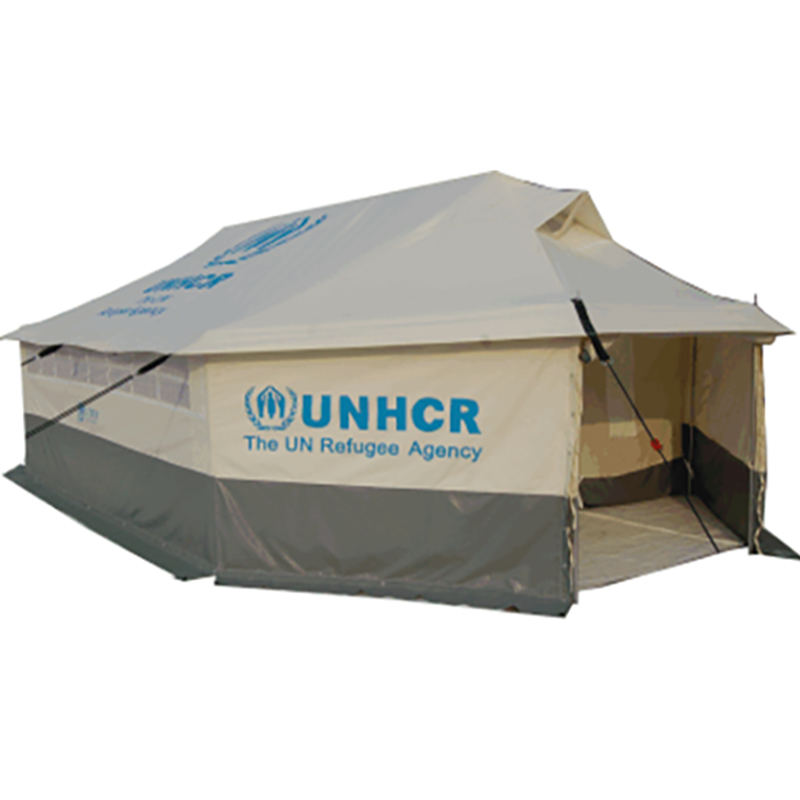
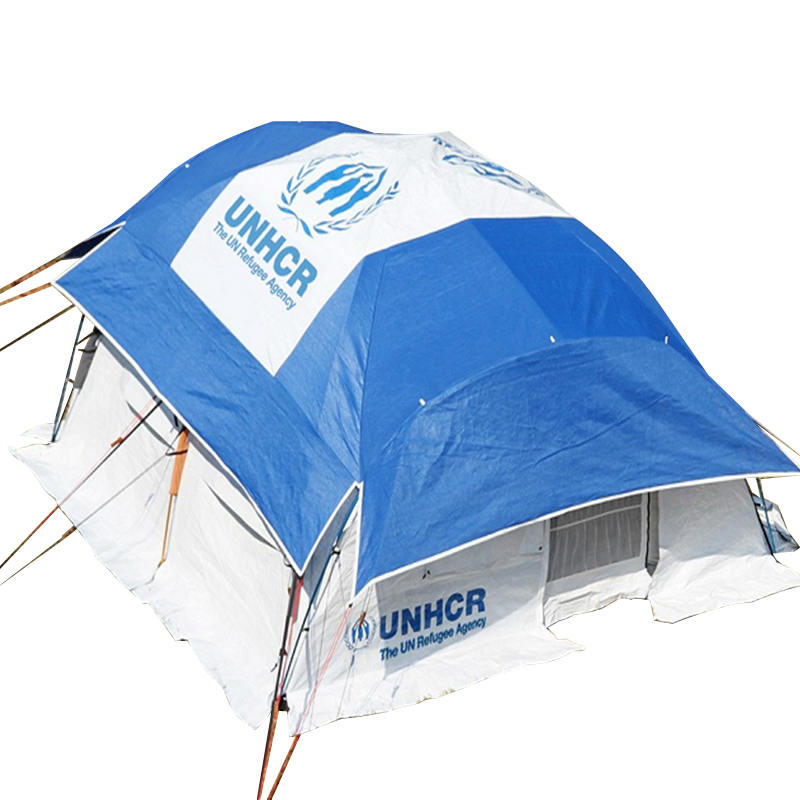
As a manufacturer and exporter working with relief organisations, retailers and distributors for more than twenty years, we build both commercial canopies and folding family shelters on the same principle: the tent is designed around how it will be packed, not only how it will be opened. A model like our ICRC, IFRC and UNHCR standard 5-person double foldable all-weather family tent is a good illustration, because the fold lines are part of the design brief and the tent is meant to be handled repeatedly by staff who did not unpack it themselves.
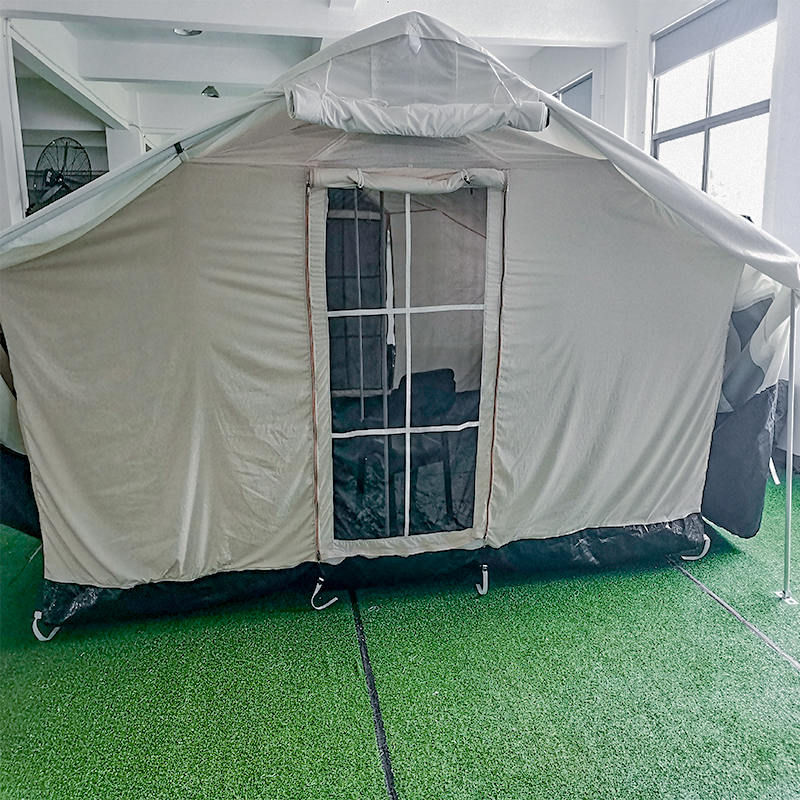 ICRC IFRC UNHCR Standard 5-Person Double Foldable All-Weather Family TentConnectable 5-person all-weather family tent Double fold Comfortable in all climates Feature : ● Water proof, rot proof and UV-stabilised ● Easy to set up and erect on...View Product →
For bulk and tender orders, specify the frame tube size, the cover material and the availability of spare legs, because those three details decide the real cost per pack-down.
If you want to go deeper into the technical side of tent construction and folding, our practical technical manual for camping tents covers frame types, fabric specifications and packing in more detail.
You can also browse the full Mailenda tent range, from pop up canopies and party marquees to camping domes, family shelters and storage tents.
In most cases the frame is still locked. A scissor canopy has a spring pin in each leg collar, and a single pin that has not fully clicked out will hold the whole roof up. Check each collar by feel, not by pushing harder. If every pin is released and the frame still resists, look for an attached sidewall, a cable tie or a peg that is holding a panel.
Yes for small camping domes and for canopies up to roughly 3 x 3 m, using the lay-down method described above. Above that size, work with two people. A large canopy is not too heavy for one person to lift, but an unsupported roof bar receives the full weight of the cover at a single point, which is exactly how bars bend.
Fold it low and fold it fast. Lower the frame to waist height on the windward side first, so the roof is no longer catching air, then work with two or three people who each hold a leg. Keep the tent between you and the wind, and never let go of the frame while a panel is loose. If gusts are strong enough to lift the frame, stop and wait.
Only if you have no other option. If you must pack it wet, open it out and dry it fully within twenty-four hours. Mold and mildew set into coated fabric quickly, and the stains are permanent. Rainwater trapped inside a folded tent also adds significant weight, which puts extra load on the frame during transport.
Relax the frame before you gather the cover, and keep the cover under tension while you pleat it. Fabric gets trapped when a leg is collapsed while a panel hangs loose inside the strut. The simplest habit is to pull the four corners around the frame before the last two legs go down, not after.
Tight enough to hold the bundle together, loose enough that the frame does not creak. If you have to kneel on the bag to close the zip, the fabric is folded incorrectly rather than simply bulky. Over-tightening compresses the coating against the frame corners, which is where pinholes and tears usually begin.
Consistent folding along the same lines is generally good for the frame and bad for the coating over a long period. Frames prefer repeatability because the struts wear in evenly. Fabric prefers variety, because the same crease loaded hundreds of times will eventually crack. Refolding along slightly different lines once or twice a season is a reasonable compromise for frequently used canopies.
Do not straighten the pole by hand and continue using it. A bent pole will not sit square, and the next set-up will pull the frame out of alignment. Mark the damaged section, remove it if the frame is modular, and fit a replacement leg or pole. For camping domes with a split fiberglass pole, tape the splinter before handling so nobody gets a fragment in the hand.
Almost every folding question has the same answer: release the lock, lower the frame, gather the fabric in order, and stop pushing the moment something resists.
Folding a pop up tent is not a test of strength and it is not a race. It is a short sequence of releases, gathers and folds that the frame is designed to follow, and the sequence changes with the tent type. Canopies fold down. Camping domes fold around. Canvas tents fold flat. Once you know which motion applies to the tent in front of you, the rest is patience and a dry, clean roof.
The habits that keep a tent working are equally simple: brush the underside before folding, never pack it wet, keep the pleats straight, store it loose, and replace a bent pole rather than straightening it. Do those five things and a pop up tent will still fold in two minutes after five seasons of use.
Related Products

Our story is about how to uphold the spirit of humanitarianism in the face of disaster, how to find solutions amidst challenges, and how to sow hope in despair.
Copyright © Yangzhou Mailenda Outdoor Products Co., Ltd.
All Rights Reserved.
Custom Tent OEM/ODM Manufacturers


