Our story is about how to uphold the spirit of humanitarianism in the face of disaster, how to find solutions amidst challenges, and how to sow hope in despair.
Content
The direct answer is that cleaning a tent, whether it is a small camping tent or a large-format pole tent used for events or relief shelter, follows the same five-step sequence: brush off loose dirt, spot clean stained areas, wash with a mild soap and water solution, rinse thoroughly, and dry completely before storage. According to REI Expert Advice, the essential steps for cleaning a tent are to brush and shake off loose dirt, spot clean dirty areas before fully immersing the tent in sudsy water, then rinse thoroughly and dry completely before putting it away. This sequence works because each step removes a different category of contamination, and skipping a step, especially the final drying stage, is the most common reason tents develop odors or mold in storage.
For a pole tent, frame tent, or any larger event and multipurpose tent structure, the same five stages apply, but the execution scales up. Instead of a bathtub, larger fabric panels are typically laid flat on a clean hard surface or hung, and instead of hand-washing in a tub, a hose and soft-bristle brush replace the sponge-and-tub approach used for backpacking-sized tents. The underlying principle stays constant across every tent category, from a family tent used for weekend camping to a disaster tent deployed in an emergency response setting: dirt left untreated abrades fabric fibers over time, and moisture left untreated invites mold.
Not every tent fabric responds to cleaning the same way, so identifying the material before choosing a cleaning method is a necessary first step. Large-format structures such as party tents, marquees, pavilions, and relief tents are commonly built from PVC-coated polyester, PE tarpaulin, TPU-coated fabric, or polyester-cotton canvas, each paired with a steel or aluminum frame, and each material has a different tolerance for soap, sunlight, and scrubbing pressure. PVC and TPU-coated fabrics are generally water resistant and can typically withstand hosing and gentle scrubbing, while polyester-cotton canvas, often used in bell tents, safari tents, and sukkah-style structures, is more absorbent and requires a longer, more thorough drying period after washing.
Aluminum and steel frame components, found in frame tents, western frame tents, and peg-and-pole tents, do not need soap at all in most cases. A dry or slightly damp cloth is usually enough to remove dust and grime, and any joints or connectors benefit from being kept dry to prevent corrosion over time, particularly for tents that are stored between seasonal deployments such as warehouse tents, storage tents, or hospital and dispensary tent structures used in temporary medical settings.
| Material | Common Use | Cleaning Notes |
|---|---|---|
| PVC-coated polyester | Party tent, event tent, storage tent | Tolerates hosing and mild soap |
| Polyester-cotton canvas | Bell tent, safari tent, sukkah tent | Needs longer drying, avoid strong detergent |
| PE tarpaulin | Relief tent, disaster tent shelter kit | Wipe down, avoid prolonged soaking |
| Aluminum or steel frame | Frame tent, pole tent, military tent | Dry cloth only, keep joints dry |
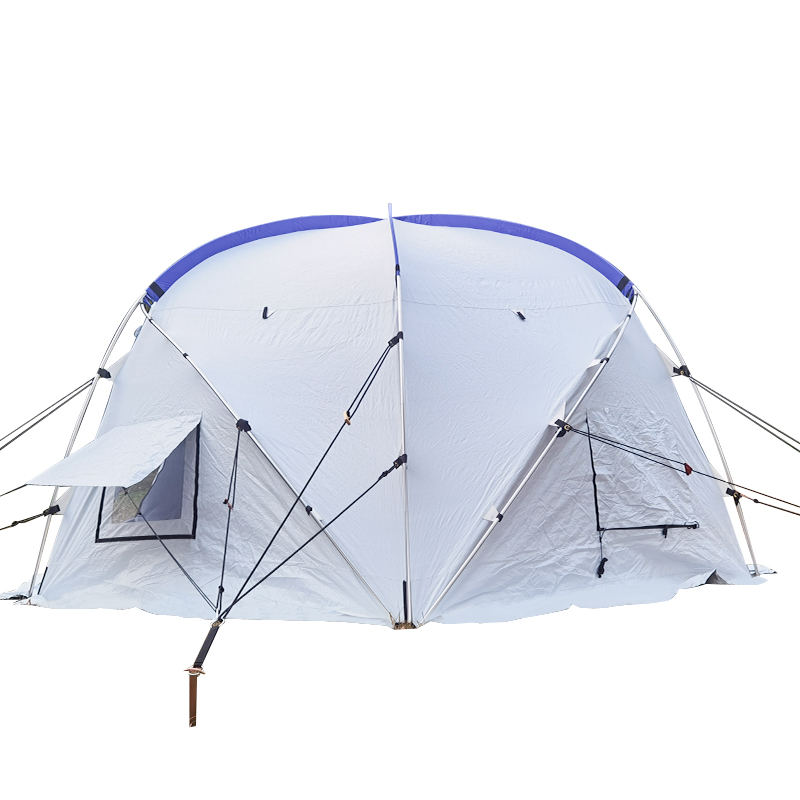
A pole tent, by design, uses a center pole or a series of poles combined with fabric tension to create its shape, which means the fabric panel is typically larger and more exposed to weather than a small dome or backpacking tent. This has a direct effect on cleaning strategy: rather than submerging the entire structure in a tub as is common practice for small camping tents, a pole tent, high peak tent, or pagoda-style pavilion is generally cleaned while partially or fully pitched, using a hose, a soft-bristle brush, and a bucket of mild soapy water applied panel by panel.
Frame tents and stretch tents used for weddings, corporate events, or as a temporary marquee follow a similar logic. Because these structures are often rented or reused across many events, dirt and grass stains accumulate at the base of the fabric walls faster than on the roof canopy, so a practical cleaning routine should prioritize the lower two to three feet of wall fabric where ground contact, foot traffic, and splashback are heaviest. For multipurpose tents used interchangeably as a wedding tent one week and a corporate event tent the next, this base-level focus keeps the visible, guest-facing sections looking presentable between full washes.
Peg and pole tents, gazebo and pergola-style structures, and geodesic dome designs used in glamping or scout camp settings share one more practical consideration: anchor points. Stakes, pegs, and guy lines accumulate soil and should be wiped down or rinsed separately from the main fabric body, since dragging a muddy peg across clean canopy fabric during breakdown is one of the most common ways a freshly cleaned tent gets re-soiled before it is even packed away.
Mold and mildew are the most damaging outcome of improper tent care, and they are almost always caused by storing fabric while it is still damp. REI Expert Advice recommends using an enzyme-based cleaner for tents affected by mildew, mold, or foul odors, and specifically warns that leaving a tent soaking longer than the cleaner's recommended time can lead to hydrolysis, a process where water begins to break down waterproof polyurethane coatings. This is a critical detail for any large-format tent owner, because the same fabric coatings used in small camping tents are also present in many PVC and TPU-coated party tents, warehouse tents, and relief shelter fabrics.
Bleach is one product that repeated authoritative sources advise against using on tent fabric. Pitchup.com's tent care guide explicitly warns that bleach can ruin a tent's waterproof and UV-resistant coating even though it may kill surface mold, and recommends milder alternatives such as diluted white vinegar, which several outdoor gear sources describe as effective at killing mold spores when used correctly and rinsed off within a reasonable time. GEAR AID's gear care guidance adds that mild soap and water is often sufficient for light mold, and that specialized deodorizing treatments can address lingering odor once visible mold has been removed, without leaving harsh residue behind on the fabric.
For relief tents, refugee tent shelters, and other structures used in humanitarian deployment, mold prevention has an added layer of importance beyond fabric longevity, since these tents may house occupants for extended periods and a musty, mold-affected shelter is a poor living environment. Practical prevention in these settings means: pitching tents with adequate airflow whenever the deployment context allows, avoiding packing folding shelters away while fabric is still wet, and inspecting canvas or PVC panels for early signs of mildew before they become embedded in the weave.
How often a tent should be cleaned depends heavily on how it is used. A backpacking or camping tent used on weekend trips generally needs a light clean after every outing and a deeper wash once or twice a season, while a party tent or event tent used repeatedly across a busy wedding and event calendar accumulates dirt far faster and benefits from cleaning after every few deployments. Relief tents and disaster response shelters occupy a different category altogether, since they are often pitched for weeks or months at a time in a fixed location, which shifts the priority from frequent washing toward regular inspection and spot maintenance rather than full cleaning cycles.
This chart illustrates a general pattern rather than a fixed rule: tents used more frequently in variable outdoor conditions, such as family and camping tents, tend to need attention after nearly every outing because dirt and moisture accumulate quickly during active use. Party and event tents fall into a middle tier, since they are handled by event crews between uses and can often go several deployments before requiring a full wash, provided quick spot cleaning happens after each event. Relief and disaster tents sit in a different position entirely, prioritizing inspection frequency over washing frequency because they remain pitched for long, continuous periods rather than being packed and unpacked repeatedly. Warehouse and storage tents, which are largely static structures, need the least frequent full cleaning but still benefit from a seasonal deep clean to prevent long-term dust and grime buildup on both fabric and frame. Military and multipurpose tents typically follow a deployment-based cycle, where cleaning is scheduled around setup and teardown rather than a fixed calendar interval, which keeps the structure ready for its next use without unnecessary handling in between.
Drying is consistently identified across authoritative outdoor gear sources as the single most important step in tent care, more important than the choice of soap or cleaning product. Pitchup.com's tent care guide notes that mold and mildew can begin forming on tent fabric in as little as a full day once conditions are damp and warm enough, which means the window between finishing a wash and fully drying a tent is not a flexible timeline, it is a genuine race against fungal growth. REI's gear care guidance reinforces this, stating plainly that stashing a damp tent in a stuff sack promotes mold and mildew growth and can trigger hydrolysis, the gradual breakdown of waterproof coatings caused by trapped moisture over time.
This area chart shows a relatively flat risk curve in the first several hours after a tent is packed away damp, followed by a sharp upward bend around the 24-hour mark, which lines up with the commonly cited guidance that mold can begin forming within about a day under the right damp, warm conditions. The takeaway for anyone managing a fleet of party tents, relief tents, or storage tents is that even a short delay in drying, if it stretches past that first day, can meaningfully increase the chance of mold taking hold. This is especially relevant for large-format tents that are broken down at the end of an event or deployment and immediately loaded for transport, since fabric folded under tension in a truck or storage container dries far more slowly than fabric left open to air. Operations teams handling multiple tents on a rotation, such as event rental companies or relief logistics coordinators managing shelter kits, benefit from building a short air-out period into their breakdown schedule rather than treating drying as an optional final step. The steep slope on the right side of the chart also explains why a tent that seemed only slightly damp at pack-up can arrive at its next use with a noticeably musty smell if enough time passed in between.
Large-format tents, including pole tents, frame tents, marquees, and relief shelters, are generally built from a combination of coated fabric for the canopy and walls, and metal for the structural frame. The donut chart below presents an illustrative composition breakdown reflecting how these material categories are typically distributed across a general-purpose fleet of party, relief, and multipurpose tents, based on common industry material choices rather than a single published statistical source.
This donut chart shows that coated fabric, whether PVC or TPU-based, generally makes up the largest single share of material used across pole tents, frame tents, and party tents, which is consistent with the fact that canopy and wall panels cover the greatest surface area of any tent structure. The frame, made from aluminum or steel depending on whether portability or heavy-duty stability is prioritized, forms a smaller but structurally critical share, since it determines wind resistance and load-bearing capacity for larger event or relief tents. Polyester-cotton canvas appears as a distinct segment because it serves specific use cases, such as bell tents, safari-style structures, and sukkah tents, where breathability and a traditional appearance matter more than pure weather resistance. The remaining hardware and fittings segment, covering zippers, buckles, guy lines, and connectors, is proportionally small but disproportionately important for cleaning, since these components trap grit and moisture differently than flat fabric panels and require separate attention during a thorough clean. Recognizing this material mix helps a buyer or maintenance team plan a cleaning kit that covers fabric, metal, and hardware needs rather than assuming one cleaning product will work uniformly across an entire tent.
Different tent fabrics respond differently to the same cleaning method, which is why a single universal cleaning product is rarely the right choice across a mixed fleet of pole tents, canvas bell tents, and PE tarpaulin relief shelters. The radar chart below compares three common large-format tent materials, PVC-coated fabric, polyester-cotton canvas, and PE tarpaulin, across five practical cleaning-relevant attributes: how safe the material is under a standard soap and water wash, how well it tolerates scrubbing without damage, how quickly it dries after washing, how well it resists mold once dry, and how easily it can be spot cleaned without a full wash cycle.
The radar chart shows PVC-coated fabric, in orange, scoring higher on dry speed and scrub tolerance, which matches its common use in party tents and warehouse structures that need fast turnaround between deployments. Polyester-cotton canvas, in dark gray, scores comparably on wash safety but lower on dry speed, reflecting its more absorbent, breathable construction that suits bell tents and sukkah-style shelters better than fast-turnaround event use. Neither material dominates every axis, which reinforces a practical point for buyers managing a mixed tent inventory: the right cleaning approach depends on matching the method to the fabric rather than applying one process everywhere. PVC and TPU-coated tents generally tolerate more aggressive hosing and scrubbing because their coating resists water penetration, while canvas requires gentler handling and considerably more drying time before it is safe to fold and store. This is also why a maintenance schedule for a mixed fleet, such as one that includes relief tents, party tents, and glamping-style canvas structures, should be organized by material category rather than by a single blanket policy applied to every tent regardless of what it is made from.
Proper storage extends the useful life of any tent, and the guidance is consistent across camping-scale and large-format structures alike: store only when completely dry, in a cool, well-ventilated space, away from direct heat sources or prolonged sun exposure that can degrade coated fabrics over time. REI's gear care guidance emphasizes that dryness is the most important factor in storage, since a damp tent packed into a stuff sack or storage bag creates ideal conditions for mold to take hold before the next use.
For organizations managing multiple structures at once, such as a warehouse tent used for temporary storage, a carport or portable garage used seasonally, or a relief tent fleet held in reserve for emergency deployment, a simple rotation and inspection log helps ensure that structures are not left folded away for years without a check. Livestock and pasture tent structures, along with greenhouse and polytunnel covers, face an additional consideration: agricultural residue and organic matter can accelerate fabric degradation if not cleaned before extended storage, making the initial wash-and-dry cycle even more important than it is for a purely decorative event tent.
Yangzhou Mailenda Outdoor Products Co., Ltd is an international trade enterprise combined with a factory, specializing in the manufacturing of relief tents, inflatable tents, party tents, carports, and warehouse tents, among other structures. The company operates advanced production equipment, including automatic cutting machines, laser machines, automatic cutting tables, automatic welding machines, high frequency machines, hot air machines, and hot air seam sealing machines, which supports consistent seam quality and fabric bonding across large-format tent production runs.
The company is recognized as one of the earliest factories in China to engage in PVC party tent production, and its team has more than 20 years of industry experience working with PE, PVC, TPU, polyester-cotton fabric, steel, aluminum, and other structural and fabric materials. This depth of material experience is directly relevant to the fabric-specific cleaning and maintenance guidance covered throughout this article, since understanding how each material behaves during production also informs how it should be cared for once it reaches the field.
Yangzhou Mailenda Outdoor Products Co., Ltd has substantial experience in international bidding and cooperation with supermarkets, and its products are exported to dozens of countries and regions including Germany, the United States, Japan, the United Kingdom, Spain, Italy, and Canada. Its customer base includes United Nations agencies, humanitarian organizations, and a number of well-known supermarkets, reflecting the dual role its products play across both everyday commercial and critical humanitarian applications, from disaster tent and refugee tent shelter kits to party tents, marquees, and multipurpose tents used in retail and event settings.
Q1: What is the fastest way to clean a pole tent after an event?
A1: Brush off loose debris while the tent is still pitched, spot clean the lower wall sections where most ground contact occurs, then hose down the fabric and allow it to dry fully before breakdown and storage.
Q2: Can bleach be used to remove mold from tent fabric?
A2: Bleach is generally not recommended, since it can damage waterproof and UV-resistant coatings on tent fabric. A diluted vinegar solution or mild soap and water is a gentler alternative recommended by several outdoor gear care guides.
Q3: How long does it take for mold to form on a damp tent?
A3: Mold and mildew can begin forming in as little as a full day under warm, damp conditions, which is why complete drying before storage is considered one of the most important steps in tent care.
Q4: Do relief tents need the same cleaning routine as party tents?
A4: Not exactly. Relief tents are usually pitched for longer continuous periods, so regular inspection and spot maintenance take priority over frequent full washing, while party tents benefit from cleaning after every few deployments.
Q5: Should tent frames be cleaned differently than the fabric?
A5: Yes. Aluminum and steel frame components generally only need a dry or slightly damp cloth to remove dust, and joints should be kept dry to prevent corrosion, unlike fabric panels which can typically tolerate a full soap and water wash.
Related Products
Our story is about how to uphold the spirit of humanitarianism in the face of disaster, how to find solutions amidst challenges, and how to sow hope in despair.
Copyright © Yangzhou Mailenda Outdoor Products Co., Ltd.
All Rights Reserved.
Custom Tent OEM/ODM Manufacturers