

 English
 中文简体
中文简体 Español
 日本語
日本語 русский
 عربى
عربى

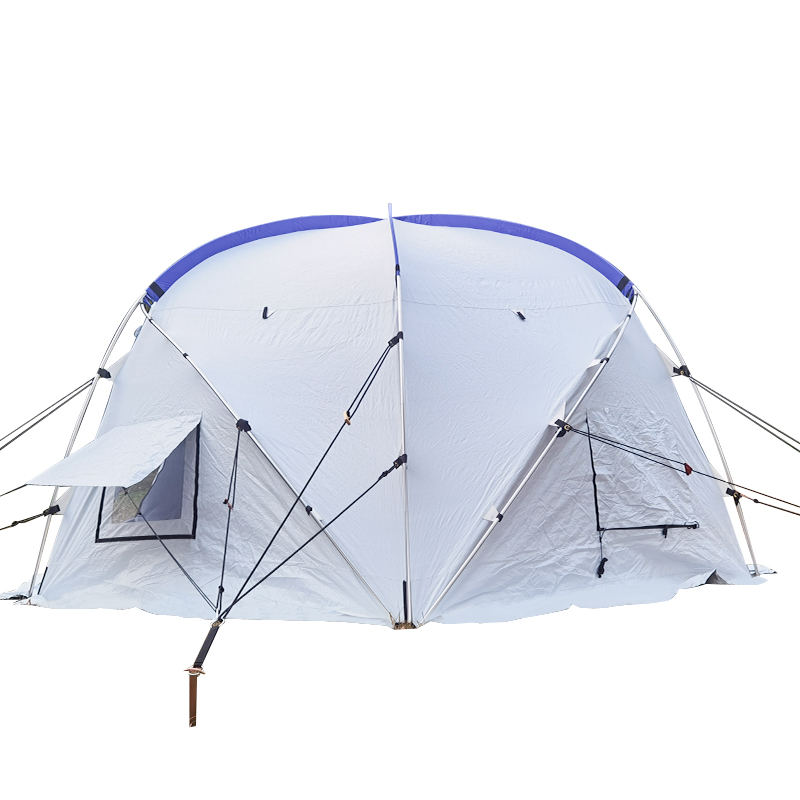


TO SHELTER ALL, TO SMILE ALL.
Our story is about how to uphold the spirit of humanitarianism in the face of disaster, how to find solutions amidst challenges, and how to sow hope in despair.
Content
The right party tent size is determined by multiplying your expected guest count by the square footage needed per person for your chosen seating style, then adding extra space for features such as a dance floor, buffet, or bar. As a general starting point widely referenced across event planning resources, standing or cocktail-style events typically require about 6 to 8 square feet per guest, while seated dinner or banquet events require closer to 10 to 12 square feet per guest[1]. For example, a seated dinner for 100 guests generally calls for a tent footprint in the range of 1,000 to 1,200 square feet, which commonly translates to a 30x40 frame tent or similar outdoor tent configuration. The remainder of this guide walks through capacity charts by guest count, how seating style changes space requirements, how a frame tent compares with a pole tent or pagoda tent, material and weather performance considerations, and installation basics.
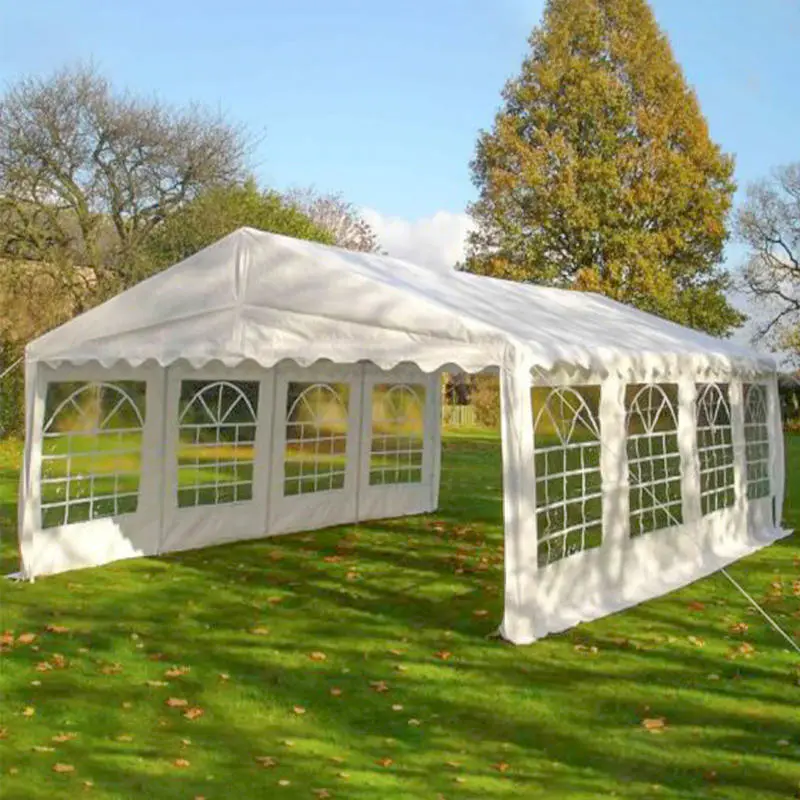
The table below summarizes commonly referenced tent footprint ranges for guest counts spanning small gatherings to large-scale events, drawing on general planning guidance from multiple event rental resources rather than a single fixed formula.
| Guest Count | Cocktail / Standing | Seated Dinner | Typical Tent Size |
|---|---|---|---|
| 50 guests | ~350 sq ft | ~550 sq ft | 20x30 |
| 100 guests | ~700 sq ft | ~1,100 sq ft | 30x40 |
| 200 guests | ~1,400 sq ft | ~2,200 sq ft | 40x60 |
| 300 guests | ~2,100 sq ft | ~3,300 sq ft | 40x90 or 60x60 |
| 500 guests | ~3,500 sq ft | ~5,500 sq ft | 60x100 or multiple units |
This horizontal bar chart visualizes how tent footprint scales with guest count for seated dinner arrangements, based on the general square-footage guidance summarized in Table 1. As guest count grows from 50 to 500, the required footprint does not increase in a strictly linear way, since larger events typically also add proportionally more space for circulation, service areas, and entertainment zones. The jump between 200 and 300 guests is particularly notable, since events at this scale often begin requiring either a single very large structure or multiple connected tent units, an approach several rental guides recommend for gatherings above 300 people. Smaller events in the 50 to 100 guest range tend to fit comfortably under a single mid-size frame tent, keeping installation logistics relatively simple. Understanding this scaling pattern helps event planners and rental businesses stock or request tent sizes that match the most common guest count brackets they serve, rather than defaulting to only one or two sizes.
Guest count alone does not determine tent size. Seating arrangement has a substantial effect on the space needed, and industry guidance from Big Dawg Party Rentals outlines distinct square-footage ranges depending on event format, from roughly 6 to 8 square feet per person for standing cocktail events up to 15 to 20 square feet per person for lounge-style seating with sofas and coffee tables[2].
This column chart shows how per-guest space requirements climb across common event formats, from the most compact cocktail arrangement to the most spacious lounge configuration. Cocktail-style standing events sit at the low end because guests circulate rather than occupy fixed seats, so a single square footage figure can serve many people at once. Ceremony or theater-style seating requires modestly more space per guest since rows of chairs need consistent spacing and center aisles for movement. Banquet seating with round or rectangular tables increases the requirement further, since tables, chairs, and serving aisles all compete for floor area, and rectangular tables in particular consume more aisle space than round ones. Lecture-style seating, often used for conferences or presentations under an event tent, needs additional room for writing surfaces and audiovisual sightlines. Lounge-style seating sits at the top of the scale because sofas, coffee tables, and open conversation areas are inherently less space-efficient than rows of chairs, which is an important consideration for planners designing a more relaxed wedding tent or hospitality lounge area.
Beyond sizing, choosing between a frame tent, pole tent, or pagoda-style marquee tent structure affects usable floor space, wind performance, and surface compatibility. Frame tents have no center poles, meaning every square foot of interior space is usable and they can be anchored on hard surfaces such as patios or parking lots, while pole tents rely on center poles that take up roughly 10 to 15 square feet of floor area each[3].
■ Frame tent ■ Pole tent - - Pagoda / high peak tent
This radar chart offers a qualitative comparison of three common structure types based on characteristics widely described across event tent planning guides, rather than a controlled engineering test. Frame tents score strongly on usable floor space and hard surface setup, since the absence of center poles and stake-based anchoring means they can be weighted down on concrete, asphalt, or gravel rather than requiring soft ground. Pole tents typically offer faster setup and a classic peaked silhouette, but their center poles reduce usable floor area and they generally require ground stakes, making them less suitable for paved surfaces. Pagoda or high peak tent structures tend to offer strong wind stability and a distinctive architectural look, which is part of why this style is popular for both wedding tent and commercial event tent applications, though setup complexity is typically higher than a standard pole tent. None of the three structure types is universally superior; the right choice depends on ground surface, wind exposure at the venue, desired aesthetic, and how quickly the tent needs to be installed and struck down for rental turnover.
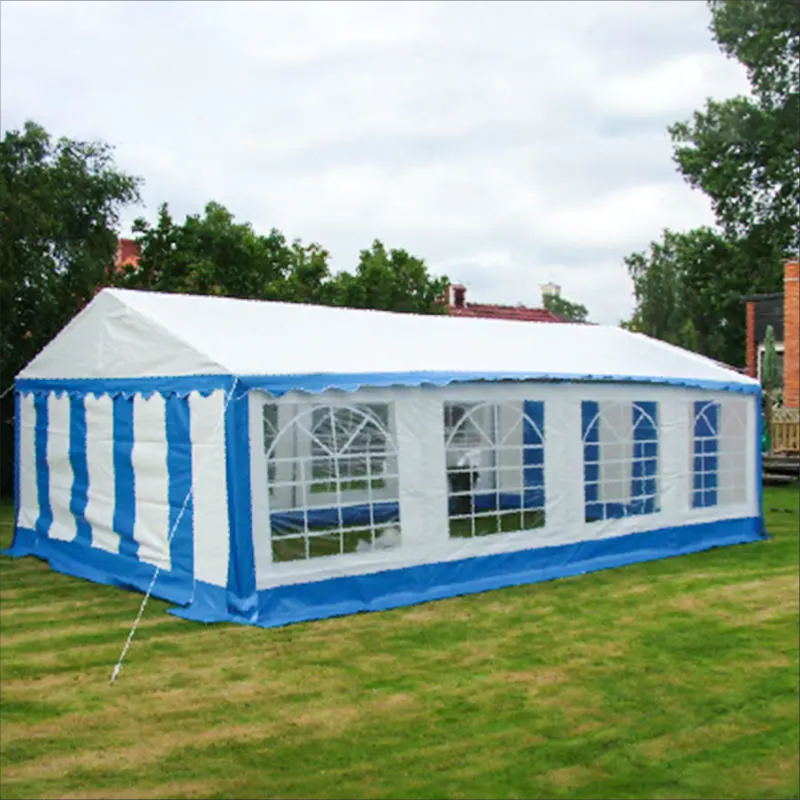
Material selection affects durability, waterproof performance, and long-term value for a heavy duty tent intended for repeated commercial or rental use. A well-built outdoor event tent generally combines three core material categories, each contributing a different function to overall performance.
Weather performance is a key factor separating a casual canopy tent from a heavy duty tent suited for professional or commercial deployment. Frame construction, fabric coating, and anchoring method all contribute to how a structure performs as wind speed and rainfall increase.
This line chart is a general illustration of how structural load margin tends to trend upward as anchoring method becomes more robust, rather than a specific engineering test result for any single product. Light stakes offer the most basic level of securing for a canopy tent or small outdoor tent, generally suited only to calm-weather, short-duration use. Standard ground stakes, driven deeper into soil, provide a meaningful improvement and are commonly used for pole tent installations on grass or soft ground. Water barrel weights are frequently used on hard surfaces where staking is not possible, offering flexible ballast that can be adjusted based on tent size and expected wind exposure. Concrete weights provide a further increase in holding force and are often specified for larger frame tent structures used at commercial venues or extended rental deployments. Engineered ground anchors, when soil conditions allow, generally provide the strongest hold of the common options, which is why they are frequently specified for large-span structures or locations with higher wind exposure. Matching anchoring method to venue surface and local weather conditions is a core part of safe tent installation, alongside the structural quality of the frame and fabric themselves.
While specific steps vary by structure type and manufacturer instructions, a general installation sequence for a party tent or event tent typically follows this order.
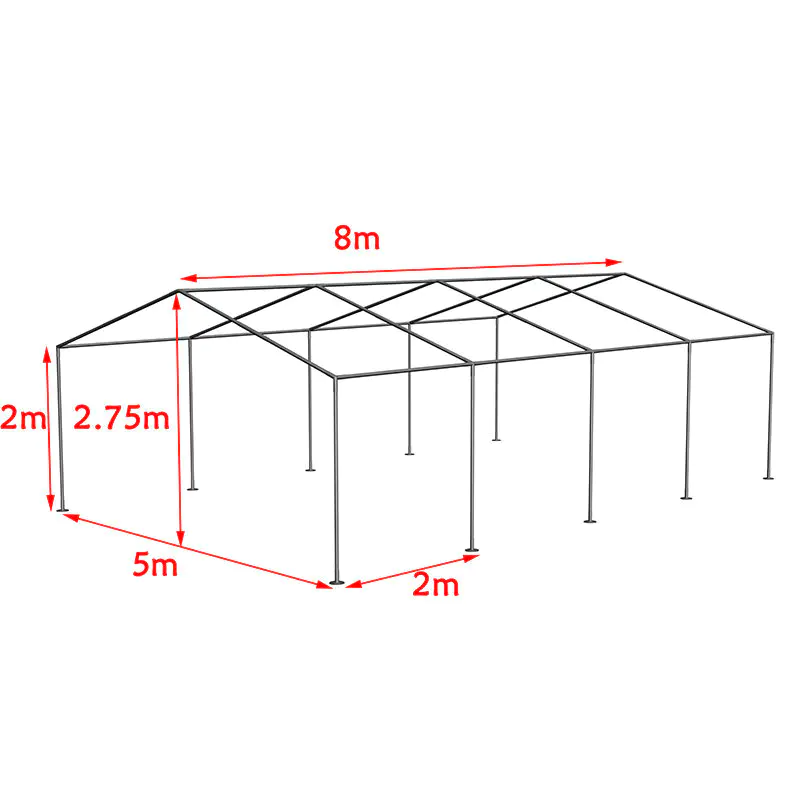
The labeled isometric diagram below illustrates the general structural layout of a typical aluminum frame party tent.
This isometric illustration is a general schematic representation rather than a photograph of a specific installed unit, intended to show the basic structural components common to most aluminum frame party tents. The peaked roof section, shown in orange, represents the PVC-coated fabric that provides the primary waterproof barrier against rain and sun exposure. The vertical members represent aluminum leg posts, which distribute the structural load down to ground level and are typically the connection point for sidewalls when enclosed configurations are needed. Cross bracing, shown running horizontally between posts, adds lateral stability and helps the structure resist wind loading from the side rather than only from above. Ground anchor points at the base of each leg post are where stakes, weights, or engineered anchors are attached during installation, consistent with the anchoring methods discussed in the wind resistance section above. Understanding this basic frame layout helps event planners and rental businesses evaluate structural quality when comparing a large party tent, commercial tent, or wedding canopy tent from different specification sheets.
The same core tent structures serve a wide range of use cases, with sizing and material choices adjusted according to the specific scenario.
Businesses evaluating a party tent supplier for ongoing rental inventory or wholesale distribution generally weigh a different set of priorities than a one-time event host. Consistency across a modular size range, availability of matching sidewalls and accessories, and manufacturing capacity to support repeat orders are common considerations when working with a wholesale party tent manufacturer. For operators building a commercial event tent for rental business use, sourcing from a wedding tent wholesale factory that can produce standardized frame components across multiple sizes helps simplify inventory management and interchangeable parts between units.
Yangzhou Mailenda Outdoor Products Co., Ltd. is an international trade enterprise combined with factory operations, specializing in the manufacturing of relief tent, inflatable tent, party tent, carport, and warehouse tent products, among others. The company operates advanced machinery, including automatic cutting machines, laser machines, automatic cutting tables, automatic welding machines, high frequency machines, hot air machines, and hot air seam sealing machines. Mailenda is among the earliest factories in China to engage in PVC party tent production, with a team that has worked in the industry for more than 20 years and holds extensive experience across PE, PVC, TPU, polyester-cotton fabric, steel, aluminum, and other materials. The company has substantial experience in international bidding and cooperation with supermarket chains, and its products are exported to dozens of countries and regions, including Germany, the United States, Japan, the United Kingdom, Spain, Italy, and Canada. Its customer base includes United Nations agencies, humanitarian organizations, and well-known supermarket chains, reflecting broad experience across both commercial event tent and large-scale structural tent applications.
Q1: What size party tent do I need for 100 guests?
A: For a seated dinner with 100 guests, a footprint of roughly 1,000 to 1,200 square feet is a common starting point, often corresponding to a 30x40 frame tent, with additional space added for a dance floor, bar, or buffet area.
Q2: How is a frame tent different from a pole tent?
A: A frame tent has no center poles, so every square foot of interior space is usable and it can be anchored with weights on hard surfaces, while a pole tent uses center poles that take up floor area and generally requires ground stakes.
Q3: What materials make a party tent suitable for outdoor weather?
A: A waterproof party tent for events typically combines PVC-coated fabric for the roof and sidewalls with an aluminum frame structure, which together support waterproof coverage and durable, repeatable assembly.
Q4: Can a rental or event business source multiple tent sizes from one supplier?
A: Yes, an experienced wholesale party tent manufacturer can typically supply a modular size range with matching frame components and accessories, which helps rental businesses standardize inventory across different event scales.
Related Products

Our story is about how to uphold the spirit of humanitarianism in the face of disaster, how to find solutions amidst challenges, and how to sow hope in despair.
Copyright © Yangzhou Mailenda Outdoor Products Co., Ltd.
All Rights Reserved.
Custom Tent OEM/ODM Manufacturers


